A standard 50-gallon electric tank water heater consumes roughly 3,500 to 4,500 kilowatt-hours (kWh) of electricity per year, representing 17% to 19% of an average single-family home’s total utility bill. Installing a smart 240V 30A water heater controller shifts high-draw 4,500-watt heating cycles away from peak Time-of-Use (TOU) utility rates, saving suburban homeowners between $180 and $320 annually without sacrificing hot shower temperature.
However, retrofitting an always-on thermal storage appliance is fundamentally different from installing a smart plug or low-voltage thermostat. Electric water heaters are high-amperage continuous loads governed by strict National Electrical Code (NEC) wiring standards, and altering heating intervals without safety guards risks bacterial growth or scalding.
This technical guide breaks down 240VAC 30A dedicated wiring, NEC Article 422.13 continuous load sizing, TOU rate arbitrage calculations, and ASSE 1017 thermostatic mixing valve rules; our editorial team compiled these specifications from electrical codes, DOE efficiency reports, and manufacturer schematics.
1. The Electrical Load: 4,500W, 240V & NEC 422.13 Continuous Sizing
Almost all residential electric storage water heaters in North America use two non-simultaneous 4,500-watt resistive heating elements (upper and lower). At 240 volts, Ohm’s law dictates the running current:
$$\text{Current} = \frac{4,500,\text{W}}{240,\text{V}} = 18.75,\text{A}$$
Under NEC Article 422.13, an electric water heater with a capacity of 120 gallons (450 L) or less is classified as a continuous load. That classification mandates that branch-circuit conductors and overcurrent protection devices (circuit breakers) must be sized for at least 125% of the appliance’s rated load:
$$\text{Minimum Overcurrent Protection} = 18.75,\text{A} \times 1.25 = 23.44,\text{A}$$
Because there is no standard 25A dual-pole breaker in common residential panels, contractors install a 30-amp, 2-pole breaker paired with 10 AWG copper conductors (Romex NM-B or conduit).
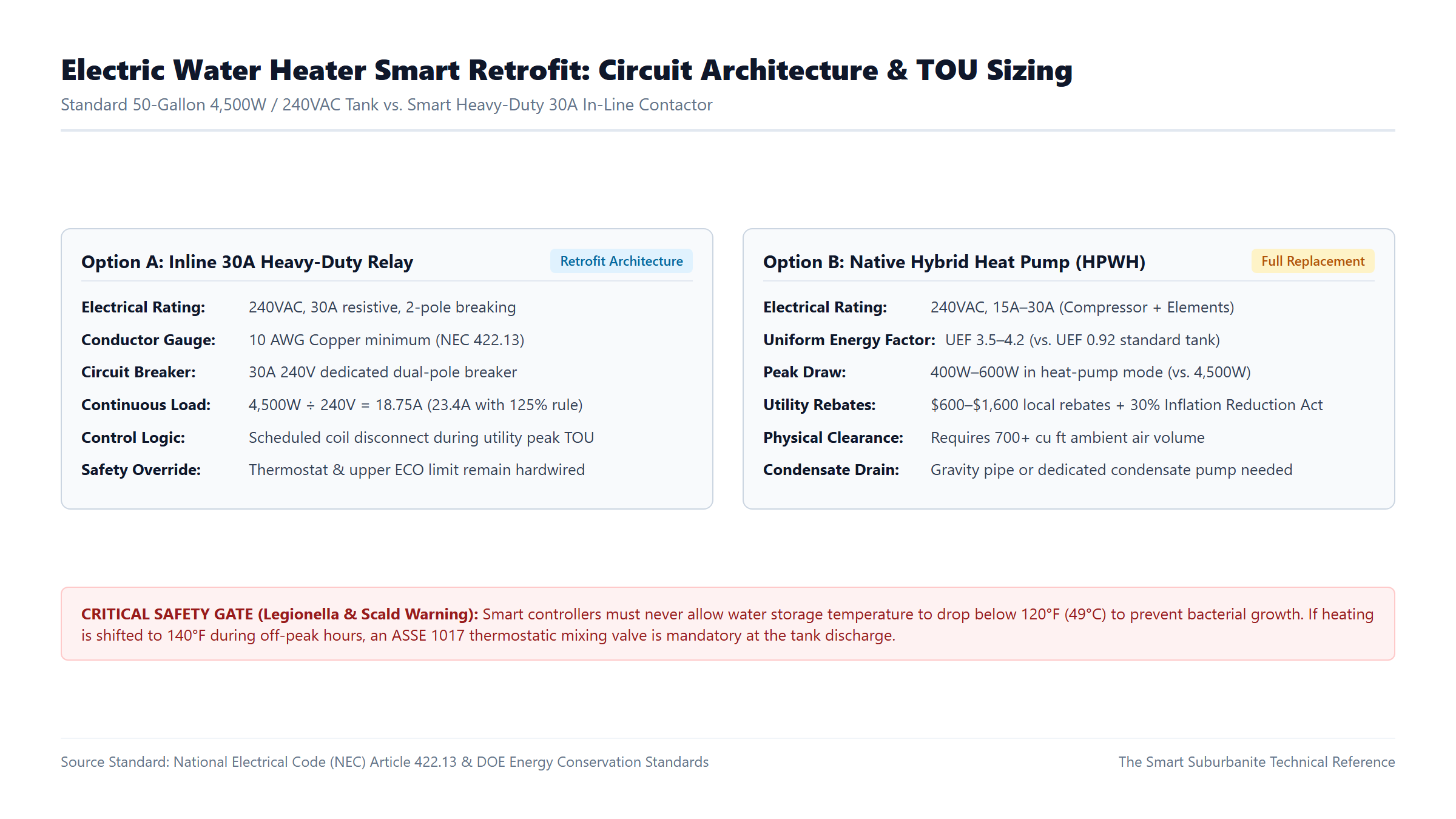
A homeowner cannot use a general-purpose 15A or 20A smart switch for this appliance. Any inline smart controller (such as an external contactor box or load controller) must carry a minimum 30A resistive rating at 240VAC and must switch both ungrounded hot legs (Line 1 and Line 2) simultaneously.
2. How TOU Rate Shifting Works (And What You Actually Save)
Smart controllers do not reduce the thermal energy required to heat 50 gallons of cold ground water from 55°F to 125°F (roughly 8.5 kWh of energy). Instead, they generate financial savings through rate arbitrage on Time-of-Use utility rate structures.
Many suburban electric utilities (such as California’s SCE/PG&E, Arizona’s APS, and Georgia Power) charge starkly tiered rates depending on the time of day:
| Utility Window | Typical Time Slot | Average Electric Rate | Cost to Heat 50 Gallons (8.5 kWh) |
|---|---|---|---|
| Peak TOU Hours | 4:00 PM – 9:00 PM (Summer/Winter) | $0.38 – $0.54 per kWh | $3.23 – $4.59 per cycle |
| Partial-Peak Hours | 12:00 PM – 4:00 PM | $0.24 – $0.32 per kWh | $2.04 – $2.72 per cycle |
| Off-Peak / Super Off-Peak | 9:00 PM – 8:00 AM | $0.11 – $0.16 per kWh | $0.94 – $1.36 per cycle |
If a standard water heater turns on during the peak 5:00 PM to 8:00 PM evening dinner rush—reheating after laundry and dishwasher cycles—it consumes expensive power.
A smart controller configured with your utility’s exact rate schedule cuts power to the 4,500W contactor during peak hours. Because an insulated water tank loses only 0.5°F to 1.2°F of ambient heat per hour (standby loss), a fully heated 50-gallon tank at 4:00 PM remains well above 118°F by 9:00 PM, providing hot showers without drawing a single watt of peak power.
- Estimated Annual Peak Savings: 2.5 kWh shifted daily $\times$ $0.25/kWh delta $\times$ 365 days = $228.12 per year.
- Controller Hardware Payback: A $90 to $160 external 30A smart relay box pays for itself within 6 to 10 months.
3. The Biological & Mechanical Safety Limits (Legionella vs. Scalding)
The primary reason water heaters are not simply unplugged on basic household timers is public health and plumbing safety. Altering water temperature curves introduces two strict boundaries:
The Lower Boundary: Legionella Bacteria (120°F / 49°C Floor)
- Legionella pneumophila bacteria thrive in stagnant warm water between 68°F and 113°F (20°C–45°C).
- OSHA and the Centers for Disease Control (CDC) guidelines state that water heaters should maintain an internal storage temperature of at least 120°F (49°C) at all times.
- Smart Controller Rule: Never program an off-peak setback schedule that allows tank core temperature to drop below 120°F. If off-peak cooling lasts longer than 6 hours in an uninsulated basement, schedule a mandatory 20-minute mid-cycle thermal refresh.
The Upper Boundary: Scalding & ASSE 1017 Mixing Valves
- Some homeowners attempt “thermal battery storage” by heating the water tank to 140°F (60°C) during cheap off-peak night hours to store extra thermal energy for the entire next day.
- Water at 140°F causes third-degree scalding burns in 5 seconds of skin contact.
- Mandatory Hardware Gate: If you set tank thermostats above 125°F to maximize off-peak energy storage, you must install an ASSE 1017-certified thermostatic mixing valve at the water heater’s hot discharge port. The valve mechanically blends cold supply water with hot tank water, delivering safe 120°F water to home faucets regardless of internal tank temperature.
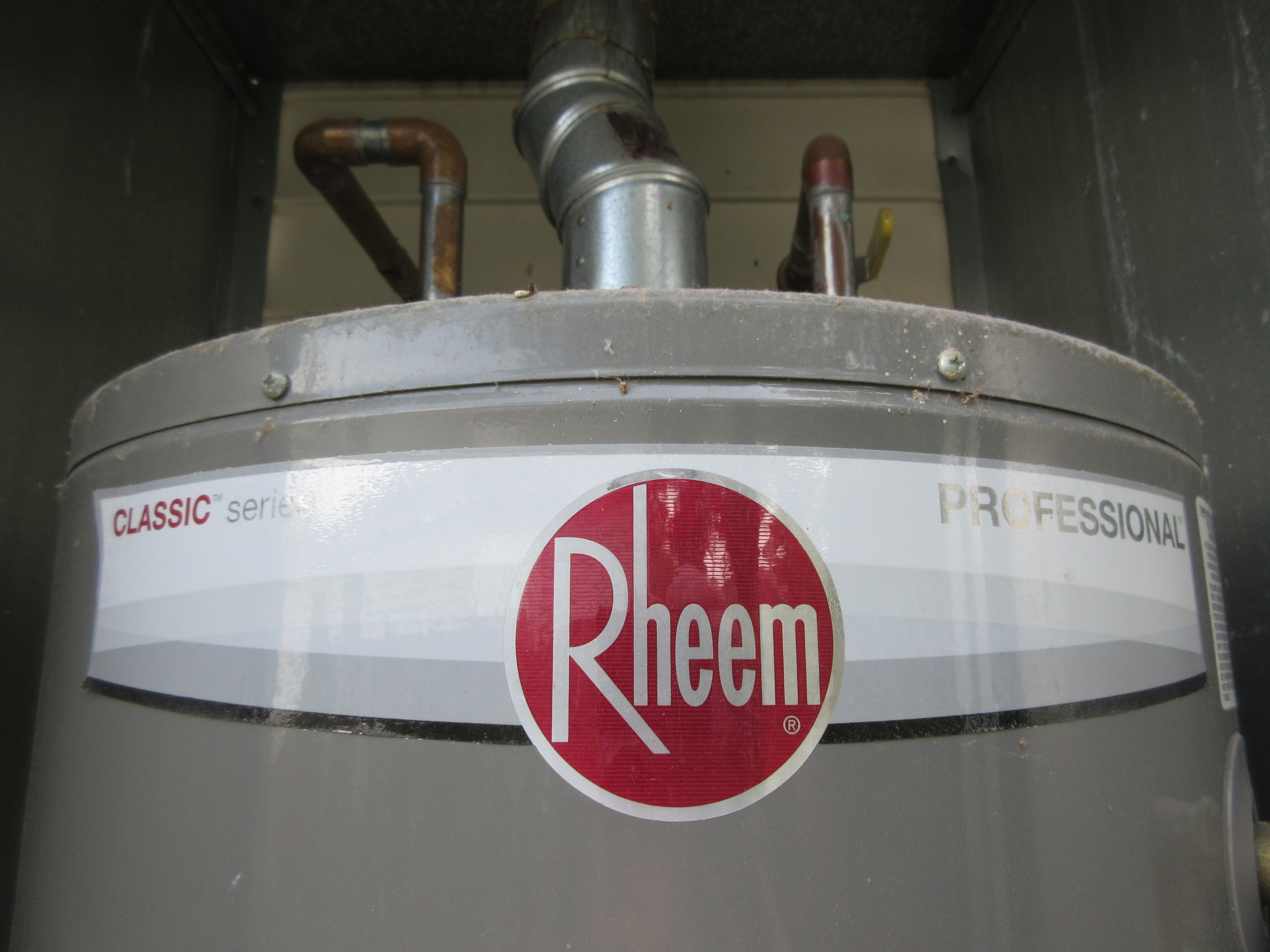 Residential storage water heater tank showing cold supply, hot discharge plumbing, and top 240V electrical conduit connection.
4. Retrofit 30A Contactor vs. Native Hybrid Heat Pump (HPWH)
Homeowners debating water heater upgrades should choose between an external 30A load controller and a full heat pump water heater (HPWH) upgrade based on equipment age:
| Decision Factor | Retrofit 30A Smart Controller Box | Native Hybrid Heat Pump Water Heater |
|---|---|---|
| Existing Tank Age | Under 6 years old (healthy tank & anode) | Over 8–10 years old (approaching end-of-life) |
| Total Hardware Cost | $90 – $180 (Contactor + App) | $1,600 – $2,800 (New unit + installation) |
| Annual Energy Reduction | 10% – 18% (via TOU rate shift) | 55% – 70% (via refrigeration cycle) |
| Electrical Draw | 4,500W during on-cycle | 400W – 600W in heat-pump only mode |
| Space & Plumbing Needs | Zero plumbing changes; mounted adjacent | Requires 700+ cu ft air volume & condensate drain |
| Available Rebates | $0 – $50 utility smart thermostat/switch | $600 – $1,600 local rebates + 30% Federal IRA credit |
5. Independent Decision Tree for Homeowners
Use this checklist before purchasing or wiring any water heater management hardware:
-
Check Your Utility Rate Plan:
- If you are on a flat-rate electric plan (e.g., $0.13/kWh all day), a smart controller saves only $15–$25 annually from minor standby reduction. Do not install a controller solely for financial ROI.
- If you are on a mandatory or optional TOU plan with a peak/off-peak delta of $0.15/kWh or greater, proceed to step 2.
-
Verify Tank Health and Age:
- Check the serial number on your tank’s rating label. If the water heater is older than 8 years, do not spend $150 on retrofit controls; save that capital for a federal-tax-credit-eligible Hybrid Heat Pump Water Heater (ENERGY STAR certified).
-
Confirm Circuit Breaker Amperage:
- Open your main distribution panel. Locate the water heater breaker. It must be a 2-pole 30A breaker. If your home uses gas water heating, this guide does not apply.
-
Add Leak Sensing with Power Cutoff:
- Pair your smart controller with an automatic flood sensor placed in the water heater drain pan. If a drip is detected, program the smart relay to cut electric power immediately to prevent dry-fired heating elements.