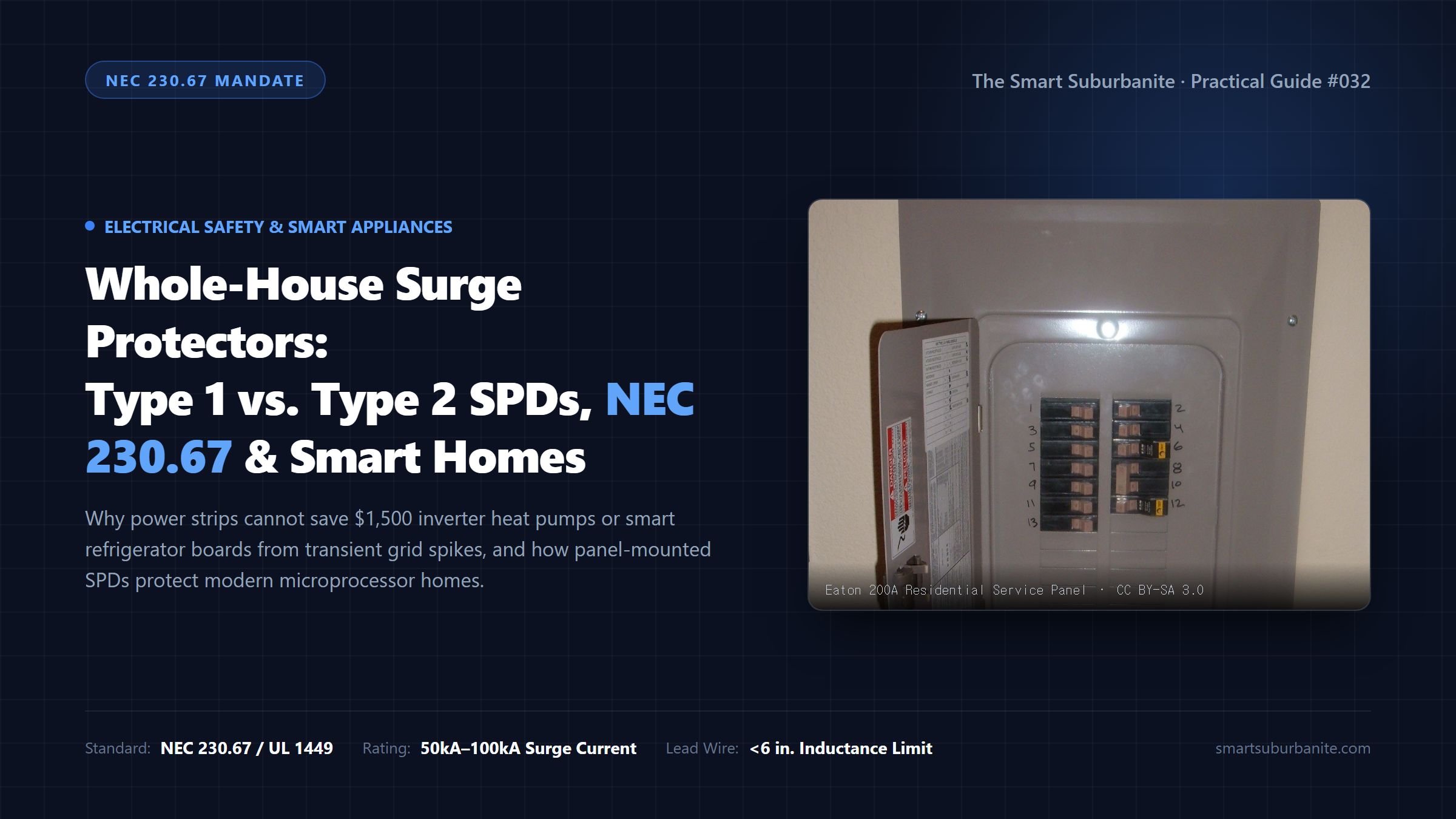
A modern suburban home contains anywhere from $15,000 to $40,000 worth of sensitive microprocessors embedded in everyday appliances: inverter-driven variable-speed heat pumps, Wi-Fi smart refrigerators, EV chargers, induction ranges, smart switches, and computerized laundry machines. Plugging sensitive electronics into $15 power strips protects desktop computers, but power strips offer zero defense when a 6,000-volt utility transient surges directly into your central air conditioner or hardwired smart lighting control boards.
Starting with the 2020 edition and reaffirmed in the 2023 and 2026 codes, National Electrical Code (NEC) Article 230.67 officially mandates that all electrical services supplying dwelling units must be equipped with an approved Surge Protective Device (SPD). Whenever a homeowner upgrades their electrical service or installs a new breaker panel, installing an SPD is no longer an optional accessory—it is a legal building code requirement.
This engineering guide explains how transient surges destroy modern appliances, dissects the technical differences between Type 1 and Type 2 SPDs under UL 1449, explains why lead wire length ($L \cdot \frac{di}{dt}$) dictates real-world performance, and outlines a multi-tiered protection strategy for suburban single-family homes.
1. The Threat: Where Do Damaging Power Surges Actually Come From?
A common misconception among homeowners is that catastrophic power surges are caused exclusively by nearby lightning strikes. Lightning certainly delivers severe, high-energy transients (often exceeding 20,000 to 50,000 amperes), but lightning accounts for less than 20% of all residential electrical disturbances.
Roughly 80% of electrical transients originate from normal utility grid switching and inside the home itself:
- Utility Grid Switching: Electric utilities regularly switch high-voltage capacitor banks to manage inductive power factor across distribution grids. These switching events generate rapid voltage spikes that travel down distribution lines directly into residential service entrance cables.
- Internal Inductive Motor Loads: Every time a 4-ton central air conditioning compressor, well pump, or vacuum cleaner cycles off, the collapsing magnetic field in the motor windings dumps an inductive voltage spike (ranging from 450V to 1,500V) back onto that phase leg of your electrical panel.
Older mechanical appliances built with heavy copper coils and bi-metallic switches absorbed these micro-transients for decades without damage. Modern appliances, by contrast, rely on surface-mount microcontrollers, digital display touchscreens, and solid-state DC inverter boards that operate at 3.3V to 5V DC logic levels.
Repeated exposure to minor 600V transients gradually degrades the silicon gate oxide inside microprocessors. An appliance does not always fail with an explosion; more often, an $800 control board in a five-year-old smart refrigerator mysteriously freezes or displays an unrecoverable communication error.
2. NEC Article 230.67: The Residential Building Code Mandate
Recognizing the vulnerability of modern residential electronics, the National Fire Protection Association (NFPA) enacted NEC Article 230.67 (Surge Protection):
- Mandatory Dwelling Unit Protection (230.67(A)): All electrical services supplying dwelling units must be provided with a surge-protective device (SPD).
- Location Requirements (230.67(B)): The SPD must be an integral part of the service equipment or installed immediately adjacent to the service equipment. (An exception permits placement at each distribution equipment downstream toward the load).
- Device Types (230.67(C)): The surge-protective device must be a Type 1 or Type 2 SPD.
- Replacement Trigger (230.67(D)): Where service equipment is replaced or upgraded (such as upgrading a 100A panel to 200A for an EV charger or heat pump), an SPD must be added to meet code.
Under this standard, an inspector will fail a service upgrade inspection if the panel lacks a compliant, listed surge protective device.
3. Type 1 vs. Type 2 SPDs: Understanding UL 1449 Classifications
Underwriters Laboratories publishes UL 1449 (Standard for Surge Protective Devices), the benchmark standard that governs all residential surge protection products in North America.
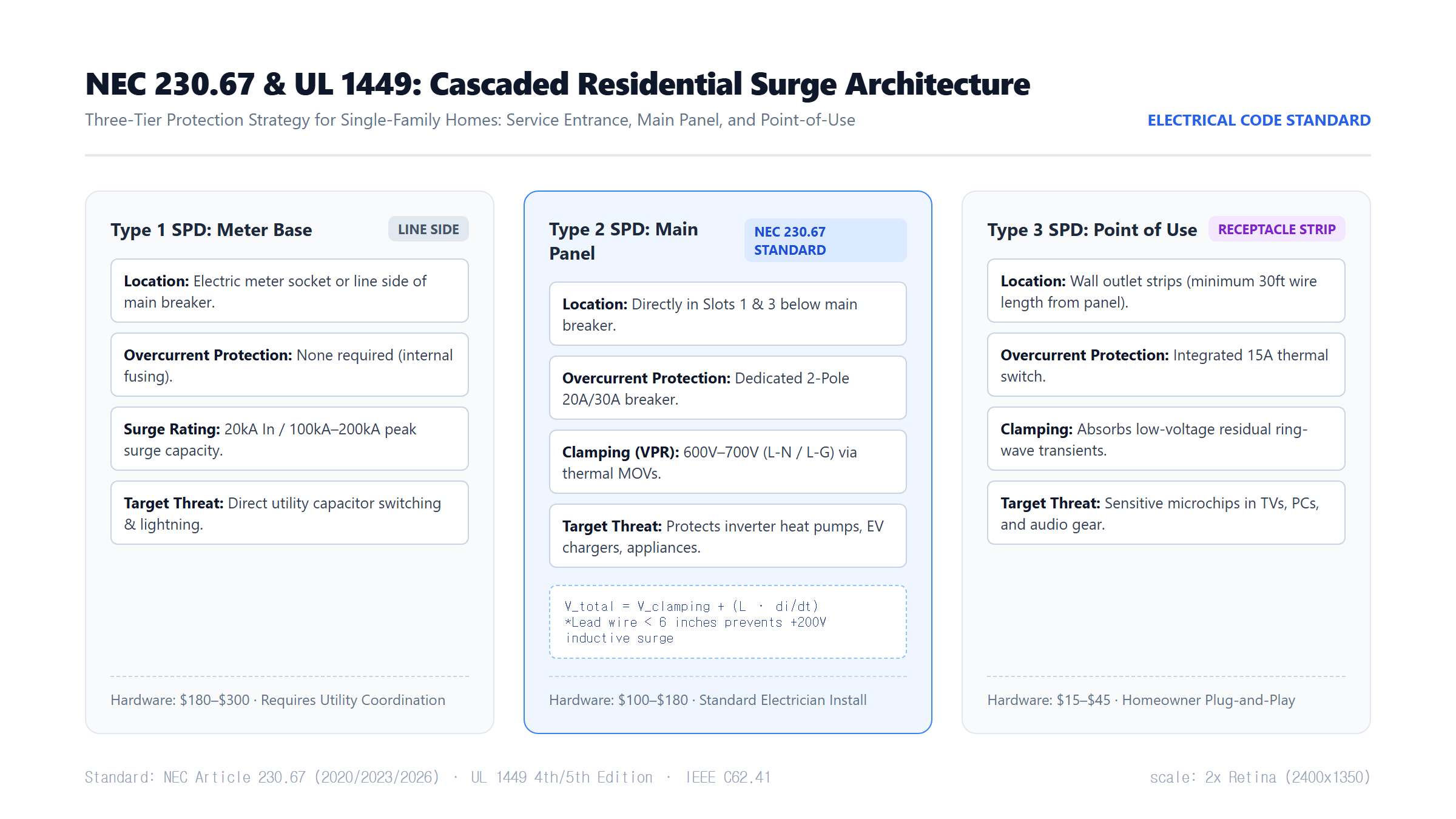
UL classifies SPDs into distinct categories based on where they connect relative to the main service disconnect:
Type 1 SPDs: Meter Base & Line-Side Installation
- Connection Point: Installed on the supply side (line side) of the service disconnect, typically between the utility electric meter socket and the main breaker, or inside a dedicated meter-main combo panel.
- Overcurrent Protection: Does not require an external circuit breaker; internal thermal disconnects handle line faults safely.
- Surge Ratings: Built with rugged enclosures rated for outdoor environmental conditions, featuring nominal discharge current ratings of $I_n = 20,\text{kA}$ and surge current capacities of 100kA to 200kA per phase.
- Installation Constraint: Because it wires ahead of the main breaker, installing a Type 1 SPD typically requires coordinating with your local electric utility to cut meter power.
Type 2 SPDs: Load-Side Breaker Panel Installation
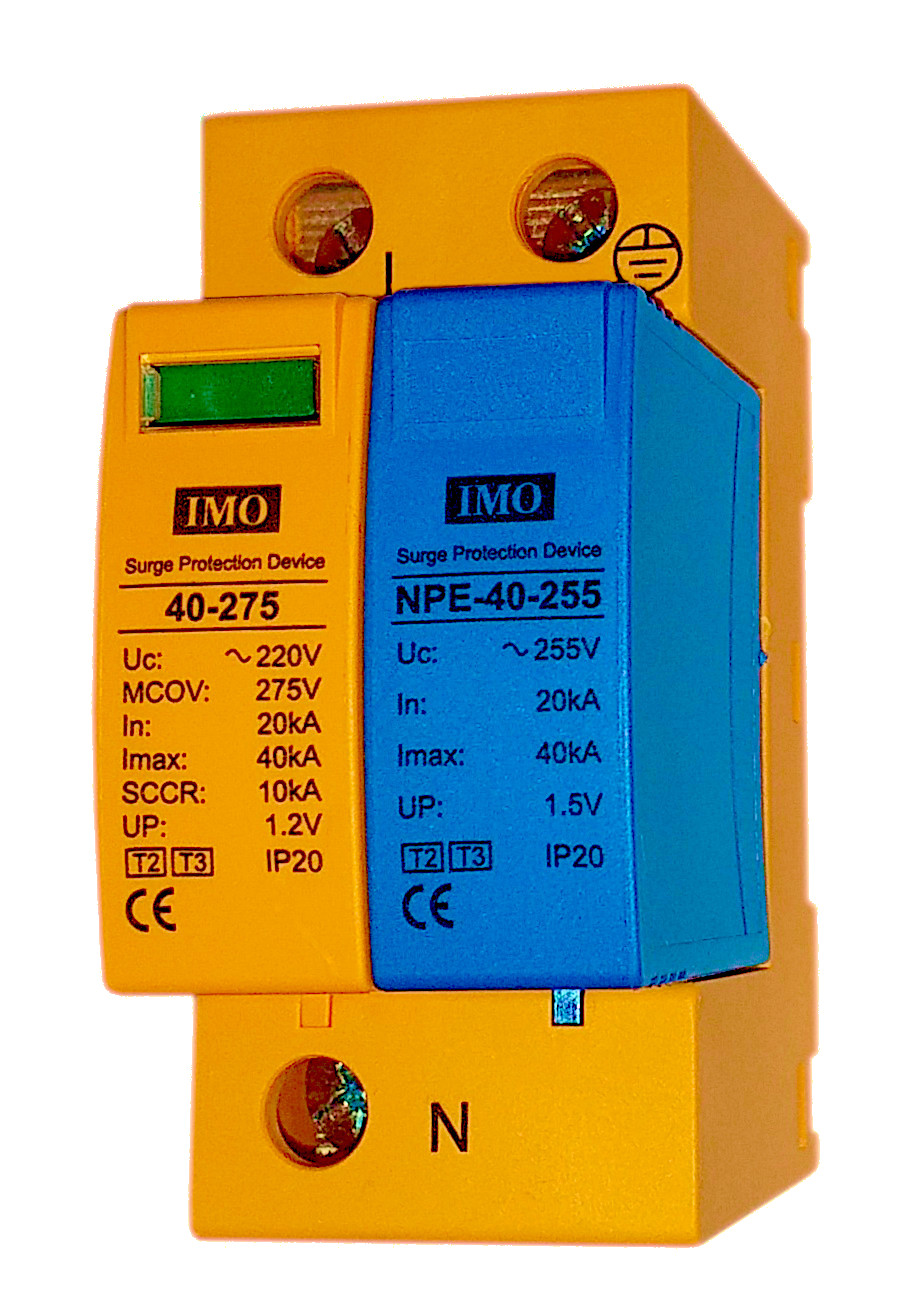
- Connection Point: Installed on the load side of the main service disconnect, mounted directly into the main circuit breaker panel or immediately adjacent via an external conduit nipple.
- Overcurrent Protection: Wires into a dedicated 2-pole 20-amp or 30-amp circuit breaker, which provides disconnect capability and overcurrent protection for the device.
- Surge Ratings: Standard residential units feature nominal discharge currents of $I_n = 10,\text{kA}$ or $20,\text{kA}$, with peak surge capacities between 50kA and 100kA.
- Installation Constraint: Can be installed safely by an electrician by simply shutting off the main 200A service disconnect inside the panel, without coordinating with the utility company.
4. Key Metrics: VPR, MCOV, and the Critical 6-Inch Rule
When evaluating whole-house SPDs from manufacturers like Square D (Schneider Electric), Eaton, Siemens, or Leviton, three technical specifications determine real-world performance:
| Specification | Technical Meaning | Target Specification for 120/240V Split-Phase |
|---|---|---|
| VPR (Voltage Protection Rating) | Clamping voltage threshold during a 6kV/3kA impulse test. | $600,\text{V} - 700,\text{V}$ (L-N / L-G) (Lower is better) |
| MCOV (Max Continuous Operating Voltage) | Max AC voltage the device can sustain without triggering. | $150,\text{V}$ (L-N) / $300,\text{V}$ (L-L) |
| $I_n$ (Nominal Discharge Current) | Tested current value survived for 15 consecutive surges. | $10,\text{kA}$ or $20,\text{kA}$ |
| Surge Current Capacity | Single-pulse maximum energy absorption limit. | $50,\text{kA} - 100,\text{kA}$ per phase |
The Physics of Wire Inductance: Why Lead Length Matters
The single most critical installation mistake made during SPD retrofits is leaving excessively long connection leads.
SPDs use Metal Oxide Varistors (MOVs) that clamp high-voltage spikes to ground within nanoseconds. However, copper wire has intrinsic inductance—roughly 20 to 30 nanohenries per inch ($nH/\text{in}$).
When an electrical surge strikes with an ultra-fast rise time (e.g., $3,000,\text{A}$ rising in $8,\mu\text{s}$), Faraday’s law of induction creates a massive voltage drop across the connection wire itself:
$$V_{\text{wire}} = L \cdot \frac{di}{dt}$$
For every additional inch of lead wire, the inductive voltage drop adds approximately 15 to 25 volts of excess voltage onto the clamping threshold:
$$\Delta V = (25,\text{nH/in} \times 12,\text{in}) \times \frac{3,000,\text{A}}{8 \times 10^{-6},\text{s}} \approx 112.5,\text{V}$$
If an electrician mounts a Type 2 SPD at the bottom of a 200A panel and routes 24 inches of wire up to a breaker, that extra wire adds nearly 250 volts to the clamping rating. A device rated to clamp at 600V suddenly subjects your home’s appliances to an 850V spike.
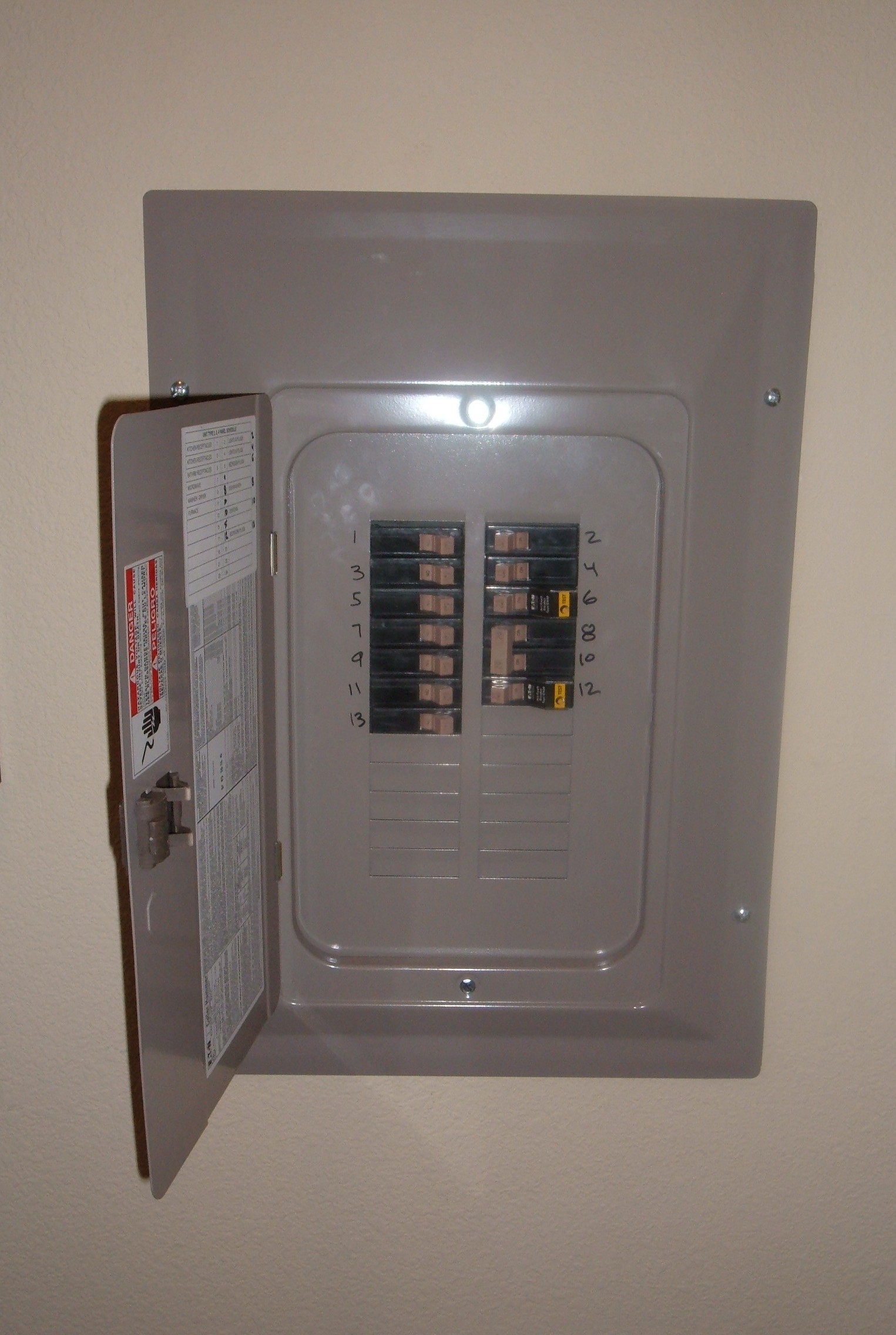
The Golden Rule: Always install the Type 2 SPD in slots 1 and 3 (the absolute top breaker positions directly adjacent to the main service lugs), and keep all connection leads trimmed under 6 inches, without sharp 90-degree bends.
5. The Three-Tier Cascaded Defense Strategy
A whole-house SPD installed at the main electrical panel cannot replace individual point-of-use surge protectors, and point-of-use strips cannot protect central appliances. The Institute of Electrical and Electronics Engineers (IEEE C62.41) recommends a cascaded, multi-tiered defense:
| Tier | Device Type | Location | What It Protects |
|---|---|---|---|
| Tier 1 | Type 1 SPD | Meter Base / Service Entrance | Absorbs large external utility transients & lightning energy (100kA+). |
| Tier 2 | Type 2 SPD | Main Breaker Panel (Slots 1 & 3) | Protects hardwired appliances: Heat pumps, water heaters, EV chargers, smart switches. |
| Tier 3 | Type 3 SPD | Point-of-Use Wall Strips | Absorbs residual voltage rings for delicate computing, home theater, and audio equipment. |
Under this coordinated setup, the Tier 2 panel SPD clamps a massive 6,000V spike down to roughly 600V. By the time that residual surge travels 30 to 50 feet through branch Romex wiring to an office bedroom, line impedance slows the rise time, allowing the Tier 3 plug-in strip to easily clamp the remaining energy down to safe 330V levels.
6. Cost, ROI & Installation Checklist
Installing a whole-house surge protector is one of the most cost-effective insurance policies a suburban homeowner can purchase:
- Hardware Cost: A reputable UL 1449 Type 2 SPD (such as a Square D HEPD80 or Eaton CHSPT2ULTRA) costs between $100 and $180.
- Installation Cost: A licensed electrician typically charges between $200 and $400 for a standard one-hour installation and panel audit.
- Homeowners Insurance Discounts: Many North American insurers offer a 3% to 7% policy discount or waive electrical damage deductibles if an approved UL 1449 SPD is documented on the panel.
- Equipment Replacement Savings: A single prevented failure on an inverter heat pump compressor control board ($1,200–$1,800) pays for the entire installation three times over.
Pre-Installation Homeowner Checklist
- Check Panel Busbar Compatibility: If you have an older panel (such as Zinsco or Federal Pacific Electric / FPE Stab-Lok), whole-house SPDs cannot fix dangerous internal busbar fire hazards; the entire panel must be replaced first.
- Verify Space: Confirm you have two adjacent open breaker slots at the very top of the panel (positions 1 and 3, or 2 and 4) to accommodate a 2-pole 20A/30A dedicated breaker.
- Inspect the Status LEDs: Check your SPD’s indicator lights every six months. MOVs sacrifice internal zinc oxide grains when absorbing massive surges. When the green status LED turns off or flashes red, the internal MOV block has exhausted its operational life and the unit must be replaced.