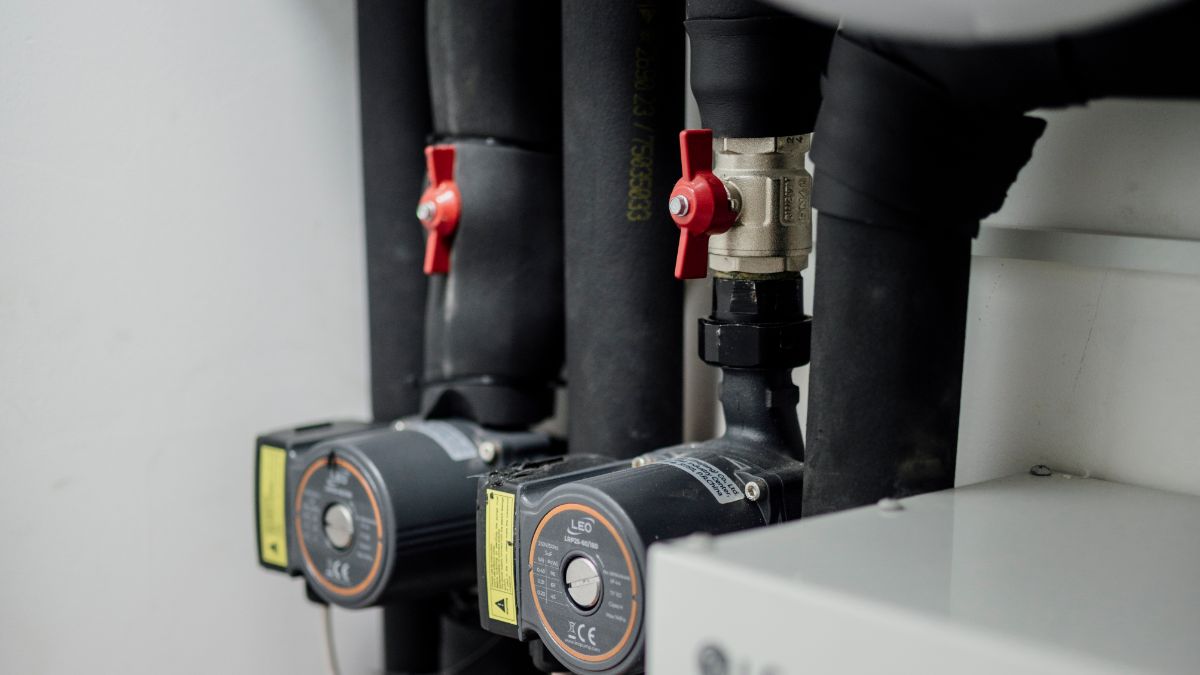
Non-weather water damage is the single most common and destructive property insurance loss in suburban residences, accounting for nearly 24% of all homeowner claims with an average payout exceeding $12,500. While small battery-powered leak pucks placed under sinks can warn of a puddle, they are powerless when a second-floor washing machine supply hose bursts at 3:00 AM while a family is traveling.
Preventing catastrophic structural flooding requires whole-home monitoring capable of cutting water at the property’s main line. Three market-leading devices dominate this space: Moen Flo, Phyn Plus, and Flume 2.
However, each relies on radically different physical sensing mechanisms, requires different plumbing interventions, and delivers distinct levels of insurance premium mitigation.
The Plumbing Lineup: Proper Component Sequencing
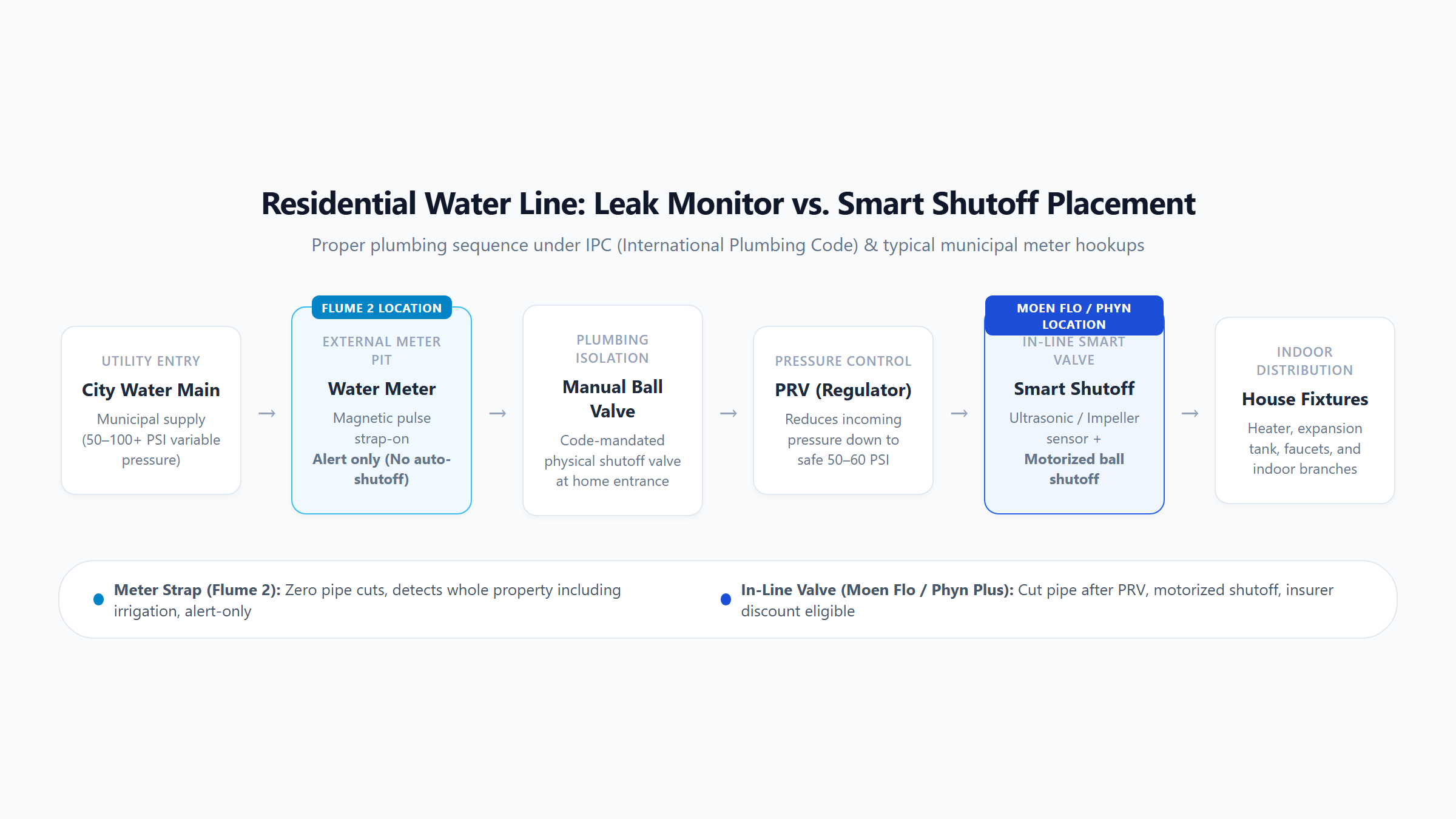
Before comparing device firmware and sensor physics, homeowners must understand where these monitoring devices sit within residential plumbing lines under the International Plumbing Code (IPC Section 606.1).
Placing a motorized valve in the wrong sequence can lead to false burst alarms, damaged sensors from municipal water hammers, or failure to isolate interior fixtures during an emergency:
The Correct Installation Order
- Municipal Water Main: Variable high-pressure municipal feed (often fluctuating between 60 to 110+ PSI).
- Municipal Meter Pit (Flume 2 Location): External to the house footprint, where municipal utility meters reside. Flume straps onto this meter body.
- Manual Main Shutoff Valve: Code-required full-port quarter-turn brass ball valve isolating the entire structure.
- Pressure Reducing Valve (PRV): Essential step-down regulator maintaining domestic line pressure between 50 and 60 PSI.
- In-Line Smart Shutoff Valve (Moen Flo / Phyn Location): Must be installed downstream of the PRV and main manual shutoff, ensuring the sensitive electronic valve body operates under regulated pressure.
- Thermal Expansion Tank & Water Heater: Closed-system plumbing requires an expansion tank on the cold inlet of the water heater, especially once a check-valve-equipped smart valve is added.
- Domestic Branch Distribution: Cold lines, domestic hot lines, and exterior frost-free hose bibbs.
Crucial Plumbing Note: If lawn irrigation branches off before the house foundation, an in-line smart valve installed inside the basement will only protect indoor plumbing. Irrigation line bursts require either placing the smart valve prior to the irrigation tee (with high-volume sprinkler schedules programmed into the valve app) or using a meter-strap monitor like Flume 2.
Core Sensor Physics: How Each System Detects Leaks
The primary mechanical difference among these three systems lies in how water movement is sensed through the supply pipe:
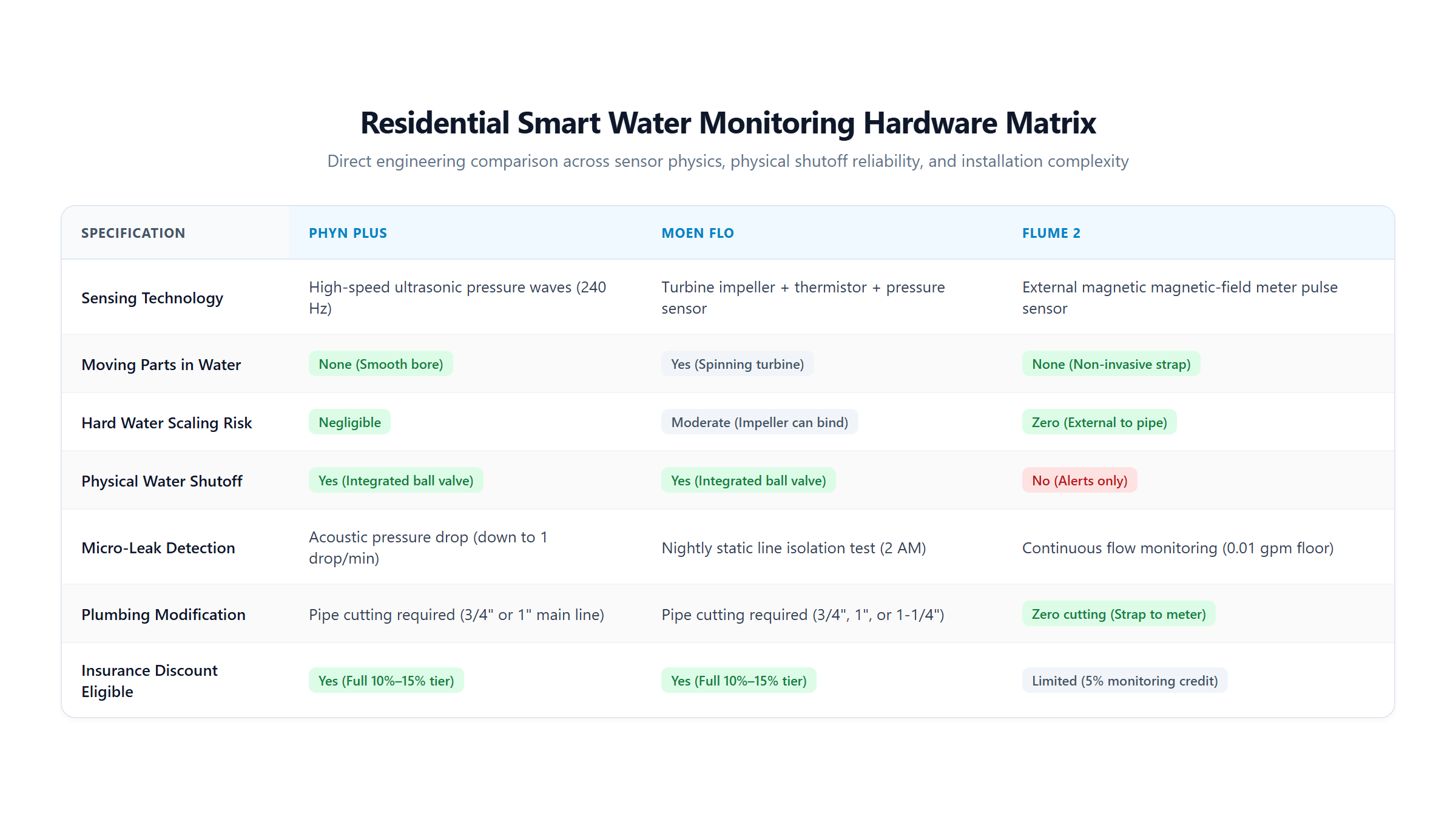
1. Phyn Plus: Ultrasonic Acoustic Wave Sensing
Phyn Plus uses dual ultrasonic transducers that sample water pressure and microscopic acoustic velocity 240 times per second.
- Smooth Bore Design: The water channel is a completely unobstructed, straight-through pipe without turbines, paddlewheels, or moving mechanical parts inside the stream.
- Hard Water Resilience: Because there are no internal moving parts, Phyn is immune to mineral scale accumulation, calcium buildup, or particulate binding in hard-water suburban regions.
- Acoustic Signature Fingerprinting: Phyn’s dual processors analyze high-frequency pressure waves created whenever a fixture opens. It can distinguish between a high-efficiency toilet flushing, a reverse osmosis filter regenerating, and an abnormal pipe rupture.
- Automated Shutoff: Features an integrated motorized ball valve that automatically cuts the main line within seconds if continuous abnormal flow or an abrupt pressure collapse is detected.
2. Moen Flo: Turbine Impeller with Static Pressure Testing
Moen Flo combines an internal spinning turbine flow meter, an electronic pressure sensor, and an ambient temperature thermistor into a single polymer/brass body.
- Micro-Leak Health Checks: At 2:00 AM (or a scheduled low-use period), Moen Flo temporarily closes its internal motorized ball valve for several minutes to trap line pressure. If line pressure decays by even a fraction of a PSI during this static hold, the system alerts to a pinhole leak or running toilet flapper losing as little as one drop per minute.
- Flow Metering: The internal turbine measures gallons used per fixture with high accuracy.
- Hard Water Consideration: In homes with high dissolved solids (over 120 PPM hardness) without a water softener, the physical turbine impeller requires occasional flushing to prevent mineral deposits from causing friction over multi-year deployments.
- Automated Shutoff: Like Phyn, Moen Flo houses a heavy-duty motorized ball valve that isolates the house upon detecting burst thresholds or freezing line temperatures.
3. Flume 2: Non-Invasive Magnetic Meter Pulse Strap
Flume 2 takes a completely non-invasive approach that requires zero pipe cutting or plumbing modification.
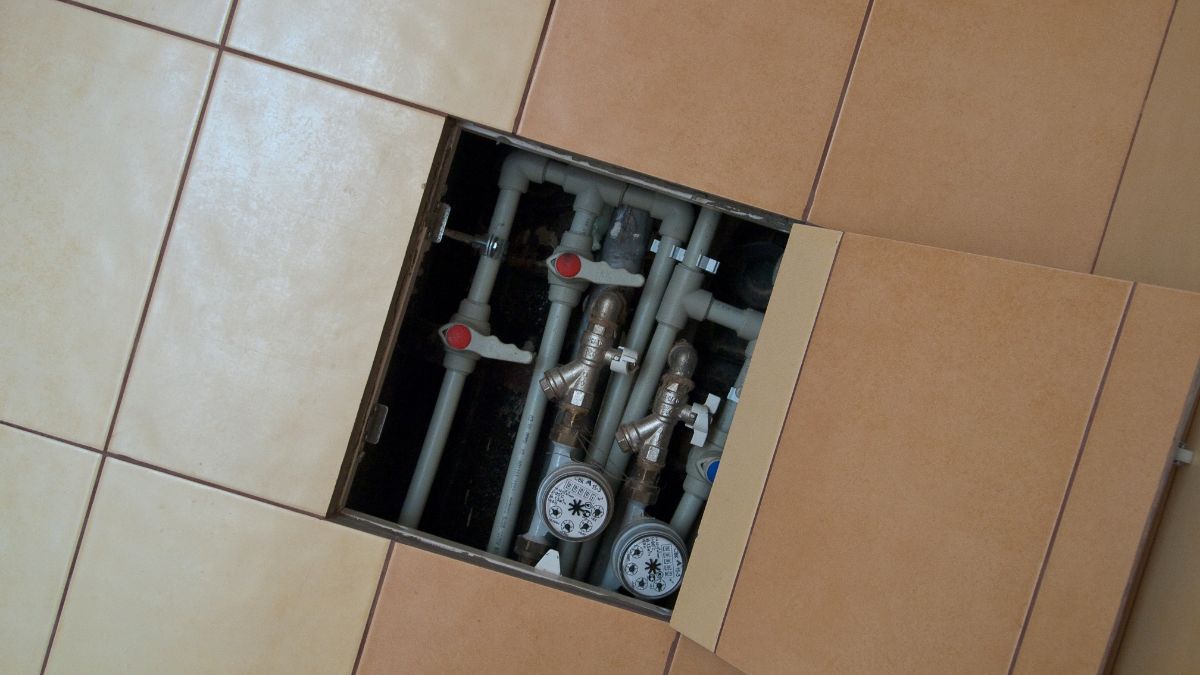
- Strap-On Sensor: It straps directly around the housing of an existing positive displacement municipal water meter (typically in an underground outdoor meter pit or utility closet).
- Magnetic Flux Detection: As the municipal meter’s internal nutating disc or oscillating piston wobbles with water flow, Flume detects the rotating magnetic field and translates it into real-time gallonage.
- Zero Shutoff Capability: Flume 2 is strictly a monitor and alerting device. It cannot physically shut off water. Homeowners receive push notifications, text messages, or phone calls when water runs continuously, but must manually close their main valve or pair Flume with third-party home automation hubs (such as Home Assistant triggering an external valve actuator).
Power Outages, Winter Freezes, and Manual Overrides
A critical vulnerability of electronic shutoff valves is handling utility power failures during severe winter storms—the exact moment frozen pipes are most likely to burst.
| Device | Power Source | Battery Backup Option | Behavior During Power Loss | Manual Override Hex Key |
|---|---|---|---|---|
| Phyn Plus | 120V AC wall outlet (15V DC transformer) | Optional external 12V UPS battery pack | Stays in last state (Default open); does not auto-close | Yes (Recessed manual override screw on valve body) |
| Moen Flo | 120V AC wall outlet (12V DC adapter) | Moen Lithium-Ion Battery Backup accessory (sold separately) | Stays in last state (Default open); battery pack provides up to 3+ days standby | Yes (Hex key included on valve housing for manual knob turning) |
| Flume 2 | 4x Internal Lithium Metal Battery Pack | 100% battery-powered (typical 1–2 year lifespan) | Continuous local monitoring, but bridge requires home Wi-Fi power | N/A (No physical valve) |
Both Moen and Phyn provide a physical hex key or manual knob mechanism on the exterior of the valve body. If power is lost and the valve is closed, a homeowner can manually crank the ball valve open without electrical power.
Insurance Discounts and Code Approvals
Before purchasing, homeowners should verify regulatory certifications to ensure their device qualifies for annual homeowner insurance policy discounts (typically 5% to 15% off the water damage portion of the premium):
- NSF/ANSI 61 & NSF/ANSI 372: Both Moen Flo and Phyn Plus carry full NSF certifications for drinking water system components and lead-free compliance, making them code-compliant for potable water main installation across all US municipalities.
- UL 1951 Certification: Standard for electric plumbing accessories. Ensures electronic valve actuators do not overheat or present electrical shock hazards in damp basements.
- Carrier Rebate Portals: Major insurers (State Farm, Nationwide, Liberty Mutual, Hippo) frequently offer subsidized hardware purchase credits ($100 to $250 off) or direct device partnerships. To claim the permanent premium reduction, the homeowner must generate an official “Certificate of Installation” directly through the device’s companion app.
Hardware Decision Matrix: Which Should You Install?
Do you have authority and budget to cut the main domestic water line?
  ├── NO (Renter, condo owner, or reluctant to hire a plumber)
  │     └── Choose FLUME 2
  │           • 15-minute zero-tool installation on municipal meter
  │           • Monitors total property (including lawn irrigation)
  │           • Alert-only (pair with smart plugs or local sirens)
  │
  └── YES (Single-family homeowner seeking automatic burst isolation)
        ├── Do you have severe hard water, high flow rates, or want zero monthly subscription fees?
        │     └── Choose PHYN PLUS
        │           • Ultrasonic sensing (zero moving parts, immune to scale)
        │           • 240 Hz pressure wave analysis with instant shutoff
        │           • High-durability brass body for demanding installations
        │
        └── Do you want nightly static micro-leak testing and seamless ecosystem pairing?
              └── Choose MOEN FLO
                    • Static 2 AM line pressure test detects 1 drop/min
                    • Broad contractor availability and standardized fittings
                    • Compatible with Moen wireless leak pucks for multi-point sensing
By matching your home’s water chemistry, plumbing access, and automation goals with the right hardware architecture, you transform your water main from an unmonitored liability into an automated, fail-safe infrastructure asset.