Water-Powered vs. Battery Sump Pump Backup Calculator
Input your home's municipal water pressure and basement lift height to calculate pumping capacity (GPH), municipal water costs, and battery runtime during an outage.
A 12-volt AGM battery backup sump pump fails after 5 to 8 hours of continuous storm pumping, leaving your finished basement completely vulnerable to a $35,000 flood during an extended multi-day electrical blackout.
If your suburban home is connected to a municipal city water main holding at least 40 to 60 PSI, a water-powered backup sump pump delivers an indefinite, zero-electricity evacuation rate of 1,000 to 1,500 gallons per hour (GPH) for days or weeks without a single battery cell to recharge, degrade, or replace.
However, water-powered backup pumps are governed by strict hydraulic and plumbing code constraints: they cannot operate on homes with private wells, they consume one gallon of municipal tap water for every two gallons of groundwater discharged, and national plumbing codes mandate certified backflow prevention to protect your family’s drinking supply.
Use the interactive sizing calculator above to evaluate your water pressure and lift head, or work through the engineering requirements below before hiring a licensed plumber or purchasing hardware.
The Physics of Venturi Jet Ejection: How Tap Water Moves Groundwater
Traditional primary sump pumps use a 1/3-HP or 1/2-HP electric motor spinning an impeller to physically push water up an ABS or PVC discharge riser against gravity. When grid power drops during a summer thunderstorm or a winter nor’easter, that motor stops instantly.
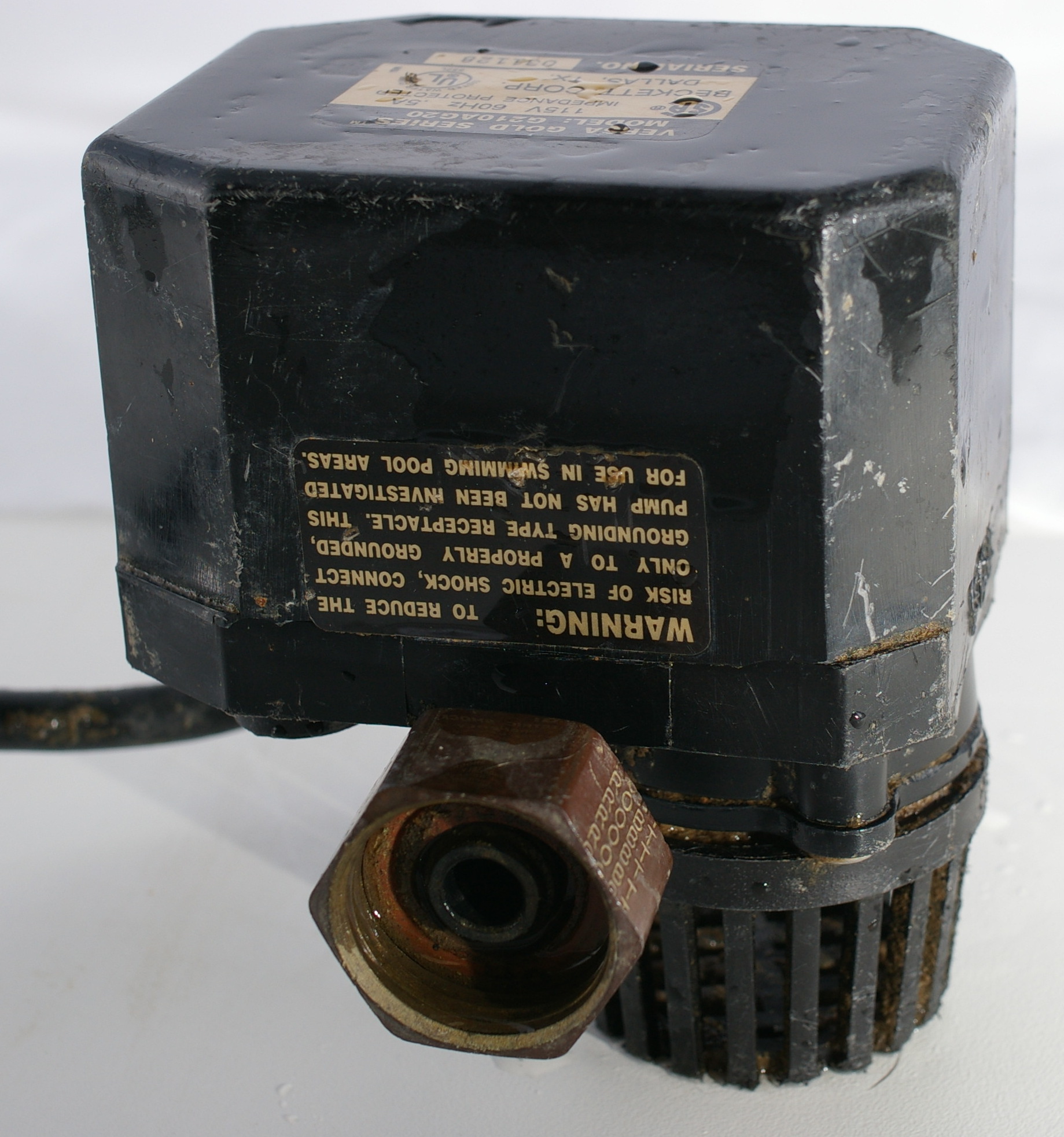 Figure 1: Authentic residential primary sump pump installation inside a circular concrete basement pit, showing vertical PVC discharge piping and mechanical check valve assembly. Photo: Hustvedt, CC BY-SA 3.0 via Wikimedia Commons.
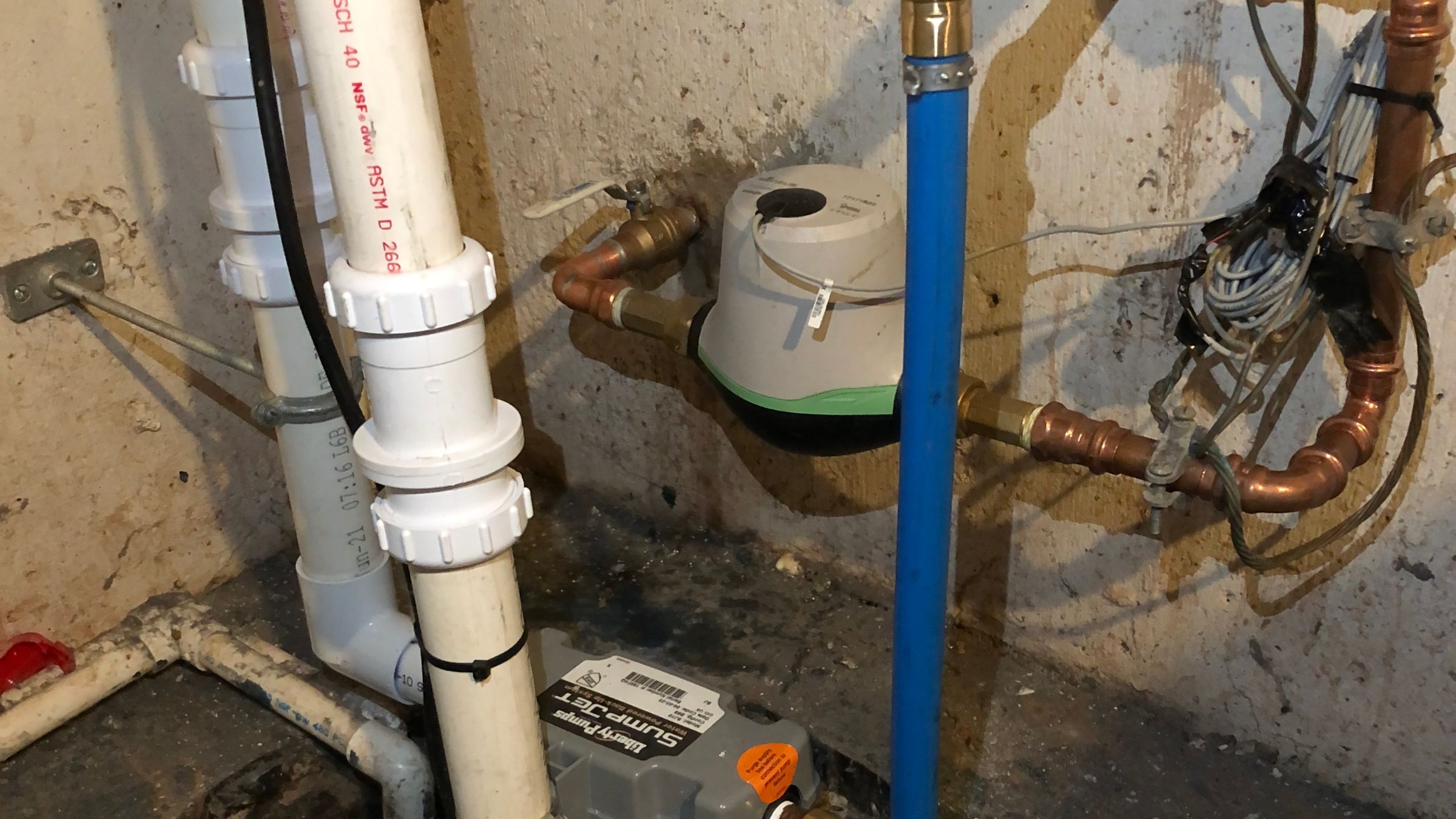
A water-powered sump pump (such as the Basepump RB750 or Liberty Pumps SJ10) contains zero electrical components, no motor, and no internal battery. Instead, it operates entirely on the Venturi Effect:
[MUNICIPAL 3/4" COPPER LINE @ 50-60 PSI]
                     │
                     ▼ (High-Pressure Inflow)
┌────────────────────────────────────────────────────────┐
│               VENTURI CONSTRICTION NOZZLE              │
│  Pressure drops rapidly as water velocity accelerates  │
└────────────────────────────┬───────────────────────────┘
                             ▼ (Creates High-Velocity Partial Vacuum)
              ┌──────────────────────────────┐
              │      SUCTION PIT INTAKE      │
              │  Pulls basement groundwater  │
              └──────────────┬───────────────┘
                             ▼
              [COMMON 1-1/2" DISCHARGE RISER]
(Exits 1 gal city water + 2 gal groundwater to exterior)- High-Velocity Kinetic Jet: Pressurized water from your city main enters a brass or cast-iron nozzle constricted down to a narrow throat.
- Bernoulli Pressure Drop: According to Bernoulli’s principle of fluid dynamics, as water velocity increases through the constriction, static fluid pressure plummets, creating a powerful vacuum.
- Submerged Lift Suction: A reinforced intake tube submerged in your sump basin draws in groundwater through an integral foot screen.
- 1:2 Eduction Ratio: At standard suburban pressures (50 to 60 PSI), the ejector pulls approximately 2 gallons of sump water for every 1 gallon of city tap water consumed.
Because municipal water towers and city distribution mains are gravity-fed and backed up by industrial water-utility diesel generators, city water lines almost never lose pressure during residential power outages. As long as city mains remain pressurized, the pump operates indefinitely.
Lift Head vs. Municipal PSI: Sizing Your Basements’s Inflow Curve
Pumping capacity in water-powered systems is directly governed by two variables: static municipal line pressure (PSI) and vertical discharge lift height (feet).
The table below contrasts real-world pumping capacity across common suburban basement layouts using a dedicated 3/4-inch supply line:
| Municipal Water Pressure | 8 ft Vertical Lift (Standard Basement) | 10 ft Vertical Lift (Deep Basement) | 12 ft Vertical Lift (High Grade / Walkout) | Emergency Rating |
|---|---|---|---|---|
| 30–35 PSI (Low) | 600 GPH | 480 GPH | 350 GPH | ⚠️ Marginal — struggles against torrential 100-year rainstorms |
| 45–50 PSI (Moderate) | 950 GPH | 820 GPH | 680 GPH | 🟢 Sufficient — handles standard high-water-table storms |
| 60–65 PSI (Standard) | 1,320 GPH | 1,150 GPH | 940 GPH | 🟢 Optimal — matches 1/3-HP electric pump output |
| 75–80 PSI (High) | 1,550 GPH | 1,380 GPH | 1,180 GPH | 🟢 Maximum — heavy commercial-grade evacuation |
Private Well Homeowners Cannot Use Water-Powered Pumps: If your home relies on a submersible well pump in your yard, do not buy a water-powered sump pump. When grid power cuts out, your well pump loses power, your pressure tank exhausts its remaining 20 gallons within two minutes, and the system stops permanently. Well-water homes must rely on 12V AGM/Lithium battery systems or dedicated generators.
ASSE 1012 & 1013 Backflow Prevention: The Non-Negotiable Plumbing Code
Because a water-powered pump connects your home’s potable drinking water directly to a pit containing stagnant groundwater, foundation silt, radon gas, and biological contaminants, every plumbing code in the United States and Canada strictly regulates installation.
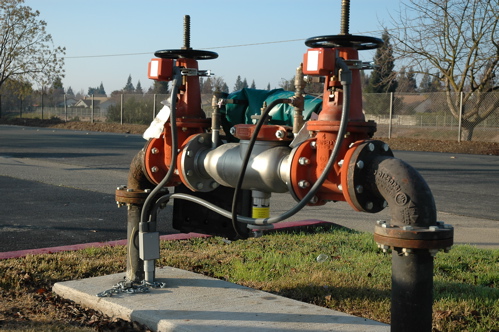 Figure 2: Real certified dual-check backflow preventer assembly installed on a copper potable water line. Dual spring-loaded check valves and atmospheric vent prevent contaminated pit water from back-siphoning into domestic drinking taps under municipal pressure drops. Photo: Mckenzieloganharris, CC BY-SA 4.0 via Wikimedia Commons.
Under the National Standard Plumbing Code (NSPC) and International Plumbing Code (IPC Section 608):
- ASSE 1012 Dual Check Valve with Atmospheric Vent: Installed on the potable water supply line upstream of the pump. If municipal pressure drops unexpectedly while the pump’s float valve is open, the mechanical vent dumps to the atmosphere, breaking the vacuum and physically preventing sump water from siphoning into your kitchen sink.
- ASSE 1013 Reduced Pressure Zone (RPZ) Device: Some high-scrutiny municipalities mandate an RPZ assembly instead of a standard ASSE 1012 valve. RPZ valves require annual backflow testing by a certified inspector.
- Dedicated 3/4-Inch Cold Water Tap: Connecting a water-powered pump to an existing 1/2-inch copper pipe or tapping in after a water softener chokes volumetric flow by up to 55%. Always tap directly into the 3/4-inch main service line immediately after the water meter and before any filtration or pressure-reducing valves (PRVs).
- Independent Discharge Riser: Plumbers should never tie the water-powered backup pump into the primary pump’s 1-1/2” discharge pipe without dual rubber check valves. If the primary check valve fails, the backup pump will cycle its own discharged water right back into the pit.
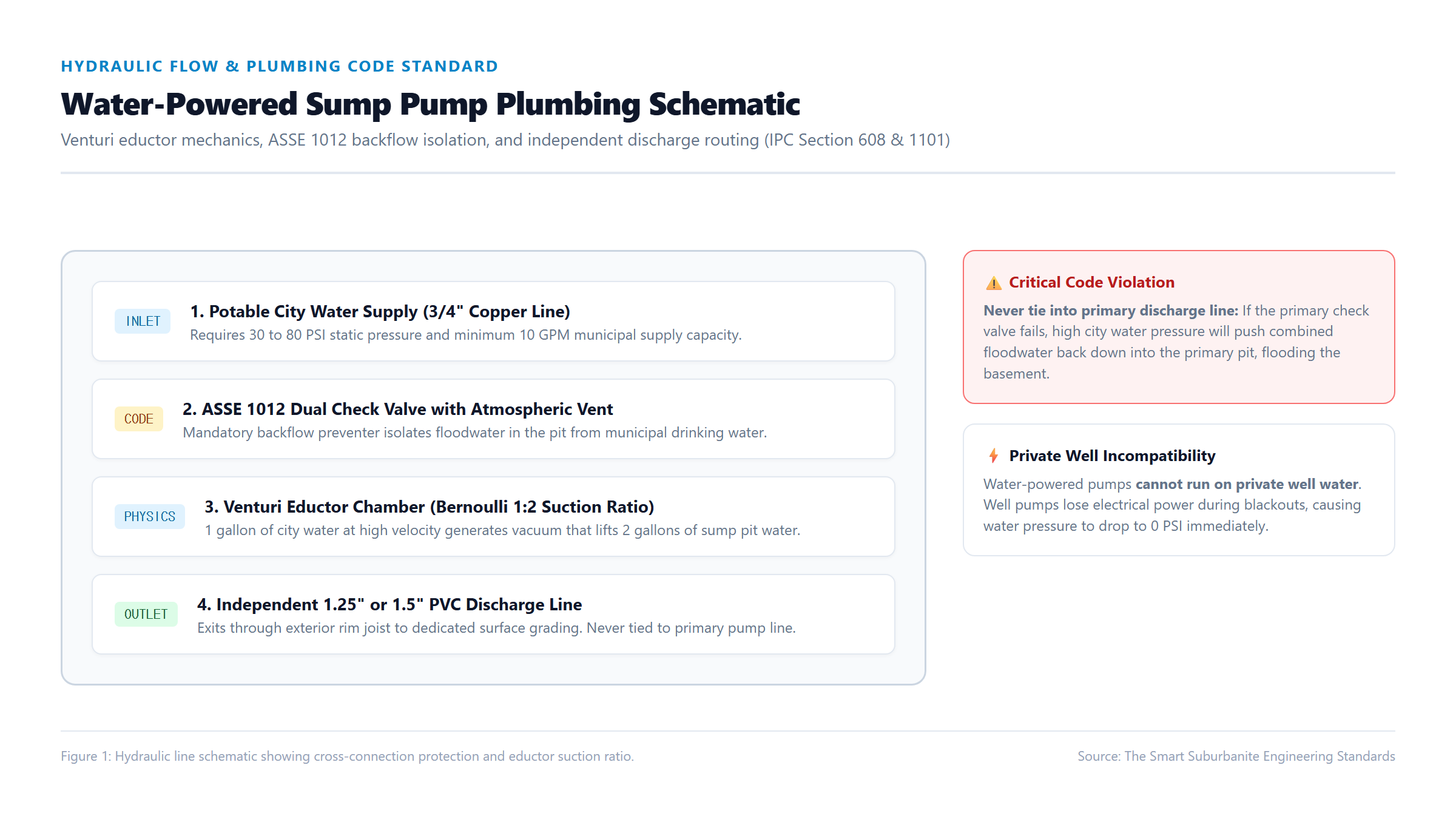 Figure 3: Engineering hydraulic flow schematic: High-pressure municipal water (30–80 PSI) passes through the ASSE 1012 backflow preventer into the Venturi constriction nozzle, creating a partial vacuum that pulls sump pit water at a 1:2 ratio through an independent 1.5” PVC discharge line. Diagram: The Smart Suburbanite.
The 12V AGM Battery Fallacy: Chemical Aging & The 6-Hour Wall
Most suburban homeowners purchase a 12V battery backup system (such as Wayne or Basement Watchdog) assuming they are fully protected. In reality, lead-acid and absorbed glass mat (AGM) chemistries present three hidden failure points during major regional disasters:
1. The 5-to-8 Hour Continuous Runtime Limit
A typical Group 27 or Group 31 deep-cycle AGM marine battery stores between 75 Ah and 100 Ah of energy.
Under moderate storm conditions where the backup pump cycles once every 3 to 4 minutes, the battery can survive 24 to 36 hours. But in catastrophic weather—where localized flooding pushes groundwater into the basin every 40 seconds—the 12V DC motor runs almost continuously at 12 to 18 amps. Within 5 to 8 hours, battery terminal voltage drops below 10.5 volts, tripping the controller’s low-voltage cut-off and leaving the basement defenseless overnight.
2. Silent Capacity Degradation
AGM batteries sit on continuous trickle chargers inside warm, humid basements. Even high-end sealed batteries lose 15% to 25% of their chemical capacity each year. Unless you perform annual load testing with an automotive carbon-pile tester, a 3-year-old battery that shows “Green / 100%” on the LED display may possess only 20 minutes of real pumping endurance under heavy load.
3. Recurring Replacement Costs
Replacing an AGM battery every 3 to 4 years costs $180 to $280, amounting to $600 to $900 in recurring maintenance overhead per decade. A water-powered pump has virtually no moving parts except an industrial mechanical float valve, lasting 15 to 20 years with zero battery replacement costs.
Comprehensive Backup Sump Pump Decision Matrix
| Evaluation Criteria | Water-Powered Backup Pump | 12V AGM Battery Backup System | Whole-Home Standby Generator |
|---|---|---|---|
| Outage Runtime | Unlimited (Days or weeks as long as city water flows) | 5 to 8 Hours (Under heavy continuous pumping) | Unlimited (Dependent on natural gas or propane supply) |
| Initial Equipment Cost | $250 – $450 | $350 – $700 (including battery) | $5,000 – $12,000 (installed) |
| Professional Install Cost | $400 – $800 (Plumbing 3/4” line & ASSE valve) | $150 – $350 (DIY friendly for basic systems) | $3,000 – $5,000 (Gas line & transfer switch) |
| Recurring Maintenance | $0 (No battery to replace; test float 2x/year) | $180–$250 every 3–4 years (Battery replacement) | $200–$400/yr (Oil, spark plugs, battery, fuel filter) |
| Noise Level | Whisper-quiet (Hiss of rushing water) | Moderate (12V DC electric motor whine) | Loud (65–72 dBA combustion engine) |
| Water Supply Cost | ~$15–$25 per 24 hours of heavy pumping | $0 | $30–$60/day (Natural gas fuel burn) |
| Well Water Compatible? | ❌ No (Strictly Forbidden) | ✅ Yes | ✅ Yes |
| Home Insurance Recognition | Qualifies for Water Backup Rider discount (5–15%) | Qualifies for Water Backup Rider discount (5–15%) | Qualifies for comprehensive premium credits |
Homeowner Decision Tree: Which Backup Should You Install?
Follow this sequential logic tree to determine your basement’s optimal flood defense:
[START: Protect Basement from Power Outage Flood]
  │
  ├─► Is your home on a private well?
  │     ├── YES ──► INSTALL DUAL 12V AGM/LITHIUM BATTERY SYSTEM or PORTABLE GENERATOR
  │     └── NO  ──► Check municipal water pressure at outdoor sillcock with a $10 gauge
  │
  ├─► Is water pressure consistently 40 PSI or higher?
  │     ├── NO  (<40 PSI) ──► Water volume insufficient; use high-capacity 12V DC battery system
  │     └── YES (40-80 PSI) ─► Check access to 3/4" cold water pipe before softener
  │
  └─► Can a dedicated 3/4" copper pipe reach the sump basin?
        ├── YES ──► INSTALL WATER-POWERED BACKUP PUMP with ASSE 1012 backflow preventer
        │           (Lowest 10-year cost, zero battery failure risk, unlimited storm runtime)
        └── NO  ──► Dual battery backup system with secondary high-water Wi-Fi alarm
The Verdict
If you live in a suburban neighborhood serviced by municipal city water with 45+ PSI, a water-powered backup sump pump is the most reliable, zero-maintenance insurance policy you can install in a basement.
While the concept of intentionally consuming tap water to pump out groundwater seems counter-intuitive, paying $20 in emergency municipal water consumption during a storm is a tiny fraction of the $35,000 mold remediation and drywall reconstruction bill caused by a dead 12V battery.
Before storm season arrives, buy an inexpensive $10 pressure gauge at your local hardware store, verify your sillcock holds at least 45 PSI, and have a licensed plumber pull an emergency 3/4-inch branch line with an ASSE 1012 backflow assembly.