
A 100-amp electrical service does not automatically require a 200-amp utility upgrade before installing a Level 2 EV charger. It also rarely has enough spare headroom for an unmanaged 48-amp charger on a 60-amp breaker. Whether your home can charge at 240 volts without replacing the service drop comes down to three concrete checks: a formal dwelling load calculation under NEC Article 220, the physical condition and bus rating of the existing load center, and whether your local authority having jurisdiction (AHJ) accepts a lower fixed charging current or a listed NEC 625.42 Energy Management System (EVEMS).
Those distinctions matter before you request contractor bids. Many daily commuters recover their full overnight mileage on a dedicated 16-amp or 24-amp 240-volt circuit, while homes with heavier electric appliances can often use a listed load-shedding or dynamic current-modulating controller to keep total service demand within code limits. Neither path is a DIY shortcut around a permit, a licensed electrician, or a damaged panel.
This guide was fact-checked on October 18, 2026. Because NEC editions and municipal amendments vary by state and city, the code edition adopted by your local AHJ governs every installation.
Start with overnight energy recovery, not the largest charger on the shelf
“Level 2” means 240-volt AC charging—not a mandatory 48-amp circuit. Under NEC 625.41, EV charging equipment is sized as a continuous load, which means the branch circuit breaker and conductors must carry at least 125% of the charger’s maximum continuous output (or the continuous load cannot exceed 80% of the breaker rating).
Before pricing a panel swap or a load controller, match your daily driving recovery against the actual power delivered during a 10-hour overnight charging window:
| Continuous Charging Current | Required Minimum Breaker (NEC 625.41 125% Rule) | Nominal Power at 240V | Energy Added in 10 Hours (Before Vehicle Losses) | Typical Residential Fit on a 100A Service |
|---|---|---|---|---|
| 16 A | 20 A | 3.84 kW | 38.4 kWh | Often fits gas-heated 100A homes without a load controller |
| 24 A | 30 A | 5.76 kW | 57.6 kWh | Strong middle ground for single-EV daily commuting |
| 32 A | 40 A | 7.68 kW | 76.8 kWh | Requires either ample load-calc headroom or listed EVEMS |
| 40 A | 50 A | 9.60 kW | 96.0 kWh | Rarely fits an unmanaged 100A calculation with electric appliances |
| 48 A | 60 A | 11.52 kW | 115.2 kWh | Typically requires a 200A service or listed dynamic load management |
A household driving 35 to 50 miles per day uses roughly 10 to 18 kWh of battery energy. Even after accounting for charging conversion losses and winter cabin preconditioning, a 16-amp or 24-amp circuit easily replenishes that daily use overnight. When using a lower fixed output to satisfy a load calculation, the maximum current must be locked via manufacturer-approved hardware dip switches or a commissioning control permitted by the adopted code—not a casual consumer app slider that anyone can raise after inspection.
Why counting breaker handles is not a load calculation—and where the DIY boundary stops
Adding up the numbers printed on your branch breaker handles tells you nothing about legal service capacity. Residential circuits never run at 100% simultaneously, which is why electricians calculate dwelling demand using the adopted edition of NEC Article 220 (commonly the optional dwelling calculation under NEC 220.82) or, where permitted by the AHJ for existing dwellings, historical peak demand data under NEC 220.87.
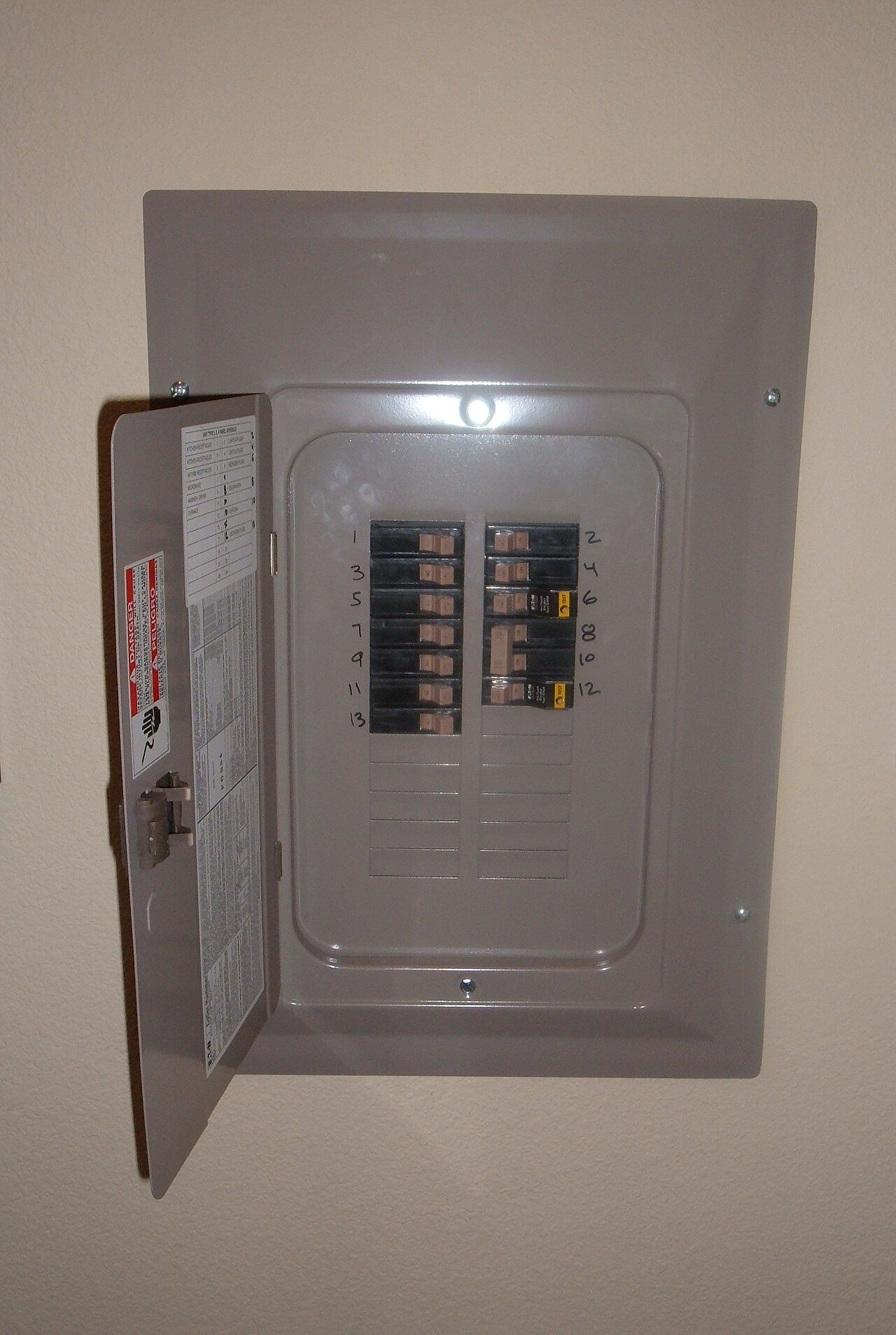 A homeowner can open the outer hinged panel door to photograph the main breaker rating, circuit directory, and open breaker spaces, but must never remove the inner metal deadfront cover. Photo: BrokenSphere / Wikimedia Commons (CC BY-SA 3.0).
You can gather useful pre-quote evidence in five minutes without touching a screwdriver:
- Open the outer hinged door of the load center and photograph the main breaker handle rating (for example,
100A) and the printed circuit directory. - Count how many full-size physical breaker spaces remain unoccupied.
- Record the nameplate electrical ratings of your major 240-volt equipment: central air conditioner or heat pump condenser, electric range/oven, clothes dryer, and water heater.
- Check whether your utility portal provides 15-minute or hourly smart-meter interval data over the past 12 months.
Critical electrical safety boundary: Stop at the outer hinged door. Never unscrew or remove the inner metal panel cover (the deadfront) yourself to inspect busbars, conductor gauges, or current transformer (CT) mounting space. Even when the main breaker is switched to OFF, the incoming utility service conductors and main lugs at the top or bottom of the enclosure remain energized at full utility fault current. Only a licensed electrician wearing appropriate protective equipment should open the deadfront or install CT clamps inside a panel.
Follow the three-step decision path before choosing hardware
Once an electrician runs the Article 220 load worksheet and inspects the load center interior, every 100-amp EV project branches into one of three code-compliant paths:
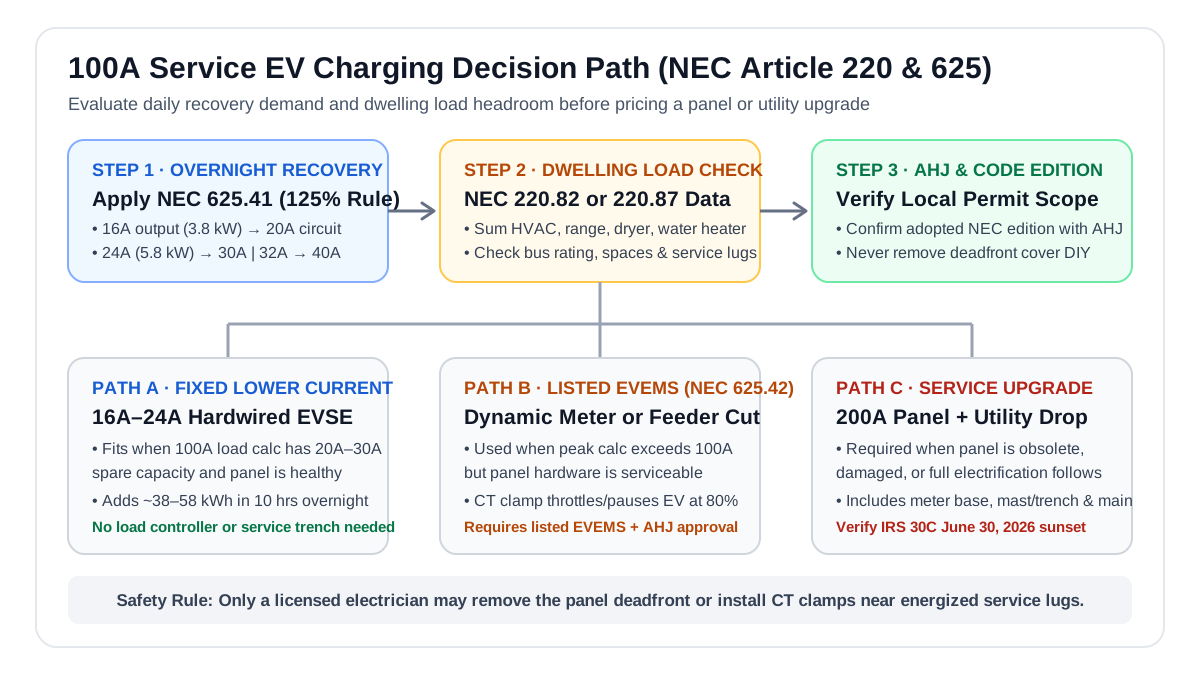 Decision flowchart: verify daily recovery needs under NEC 625.41, complete the NEC 220.82 or 220.87 load calculation, and select lower fixed current, listed NEC 625.42 load management, or a 200A service upgrade.
How NEC 625.42 Energy Management Systems (EVEMS) work
When a home’s calculated peak demand leaves too little room for a fixed 32-amp or 48-amp circuit, modern NEC editions provide an engineered alternative. As summarized in the U.S. Department of Energy’s residential NEC guidance, 2023 NEC Sections 220.57, 220.70, and 625.42 allow a listed Energy Management System to control EV charging so that the service calculation uses the maximum load permitted by the automatic control system rather than the charger’s standalone nameplate rating.
Two distinct hardware architectures are used in residential installations:
- Dynamic current modulation (EVSE + communicating meter): Split-core CT clamps on the main service conductors feed real-time household amperage data to the wall charger. When the oven and AC compressor turn on, the EVSE smoothly throttles charging current down (for example, from 40A to 18A, or down to a pause state) so total panel current never crosses the configured ceiling.
- Automatic feeder load shedding (inline energy management controller): A dedicated contactor box sits between the breaker panel and any compatible third-party EV charger. When total service load exceeds 80% of the main panel rating, the controller opens the relay to pause charging, then re-energizes the circuit after household demand drops for a programmed recovery delay.
| System Architecture & Documented Example | How Load Is Measured & Controlled | Documented Behavior When House Load Spikes | Key Pre-Purchase Verification |
|---|---|---|---|
Dynamic Meter + EVSE (Wallbox Pulsar Plus + hardwired Power Meter) | Hardwired RS-485 communication cable between service CTs and charger | Dynamically lowers charging amperage step-by-step down to minimum or pause | Confirm exact meter model, twisted-pair cable route, and installer-locked max current setting |
Cloud/Local Ecosystem EVEMS (Emporia EV Charger + Vue Energy Monitor with PowerSmart) | Main CTs in Vue monitor coordinate charging output via PowerSmart | Adjusts EV charging rate to stay under configured main breaker threshold | Verify supported hardware generation, paid software upgrade rules for older units, and AHJ acceptance |
Inline Feeder Controller (RVE DCC-9 Energy Management System) | Integrated CTs and contactor inline with a dedicated EVSE feeder (up to 40A/50A) | Cuts power to EVSE when panel load exceeds 80%; restores after timed delay | Confirm enclosure mounting space, service conductor routing, and whether EV handles power cuts cleanly |
None of these controllers magically repairs an obsolete panel, creates physical breaker slots, or upgrades undersized service entrance conductors. The electrician and local inspector must approve the complete listed system, including how the maximum amperage limit is secured against casual tampering and how the unit fails safe if a sensor wire is disconnected.
Five situations where a 200-amp service upgrade is still the right call
Smart load management solves a calculation bottleneck on a healthy 100-amp panel, but a full 200-amp service replacement remains the smarter investment when:
- The existing load center is damaged, recalled, or obsolete: Panels with heat-discolored busbars, moisture corrosion, ungrounded subfeeds, or documented breaker-trip defects need replacement for fire safety regardless of EV charging.
- Calculated base load already crowds 80 amps continuously: An all-electric home running resistance baseboard heat, an electric water heater, an electric dryer, and an electric range can trigger frequent, multi-hour EVEMS pauses during winter evenings.
- Additional electrification is planned within 2 to 5 years: If you plan to replace a gas furnace with a cold-climate heat pump, add a heat-pump water heater, or charge a second EV, paying once for a 200-amp panel avoids buying an interim load controller you will soon outgrow.
- No compliant breaker spaces remain: If the panel is already maxed out with tandem breakers where allowed by the panel directory, adding a 2-pole EV circuit or inline controller may still require a subpanel or load-center replacement.
- Your utility offers a panel-upgrade rebate: Several electric utilities fund service panel or meter-collar upgrades even now that the federal tax credit has expired.
Compare three written contractor scopes side by side
Because utility drop locations (overhead mast vs. underground lateral trench), meter sockets, grounding electrode upgrades, and municipal permit fees vary dramatically by property, national internet cost averages are unreliable for budgeting. Ask licensed electrical contractors to quote the same project across three written scopes:
| Written Quote Scope | Exact Line Items the Contractor Must Specify |
|---|---|
| Scope 1: Lower Fixed-Current EVSE (16A or 24A) | NEC Article 220 load worksheet, breaker size (20A or 30A), wire gauge and conduit run, hardware-locked EVSE amperage setting, permit fee |
| Scope 2: Listed EVEMS Managed Charging (NEC 625.42) | Controller/meter model number, CT clamp placement on service conductors, communication wiring path, fail-safe disconnect behavior, AHJ code citation |
| Scope 3: Full 200A Service & Panel Upgrade | Utility coordination fee, meter base, mast or underground trenching, 200A main breaker panel, arc-fault/GFCI breaker replacements, grounding upgrade, drywall/stucco patching |
Federal tax rule update: IRS Section 30C ended on June 30, 2026
If you read older blog posts or contractor flyers promising a 30% federal tax credit up to $1,000 for home EV chargers and load-management devices, check the statutory cutoff date. Under IRS guidance for Public Law 119-21, the Section 30C Alternative Fuel Vehicle Refueling Property Credit for individuals applied only to qualifying property placed in service in an eligible low-income or non-urban census tract through June 30, 2026.
The IRS explicitly states that the credit is not allowed for property placed in service after June 30, 2026. Signing a contract or paying a deposit before the deadline does not qualify an installation completed after June 30, 2026. Evaluate every new late-2026 electrical quote assuming $0 in federal Section 30C tax credits, and verify any active state or utility rebates directly with your utility’s current program rules before signing.
Checklist of questions to bring to your electrician and inspector
Before purchasing an EV charger or load controller, get clear answers to these eight questions during the on-site walkthrough:
- Which NEC edition and local municipal amendments does our building department enforce today?
- Can I have a copy of the completed NEC 220.82 load calculation or NEC 220.87 demand worksheet for my records?
- Does a fixed 16-amp (3.8 kW) or 24-amp (5.8 kW) circuit pass the load calculation without adding a load controller?
- If we use an EVEMS controller under NEC 625.42, is there safe physical clearance around the service entrance conductors to clamp the CTs?
- How does the proposed EVEMS behave if the communication cable or local Wi-Fi router loses power—does it drop to a safe fallback current or open the circuit?
- How is the maximum charging current locked so it satisfies the electrical inspector?
- What utility-side work (overhead service drop vs. underground lateral trench) would be triggered if we upgraded to 200 amps instead?
- Which planned appliances (heat pump, induction range, second EV) would exceed this design over the next five years?
Primary sources
- US Department of Energy: 2023 NEC changes for residential energy efficiency and electrification
- US Department of Energy: Vehicle-Grid Integration Strategy release and download
- ENERGY STAR: Make Your Home Electric Ready
- IRS: Alternative Fuel Vehicle Refueling Property Credit for individuals
- IRS FAQ on the June 30, 2026 Section 30C termination
- Wallbox: Activate dynamic load management
- Emporia: PowerSmart settings and configuration
- RVE: DCC-9 load-management product information