
One Tesla Powerwall 3 stores 13.5 kWh of usable energy and delivers up to 11.5 kW (48A) of continuous backup power. By contrast, a 26 kW-class home standby generator delivers 22.5 kW on natural gas or 26 kW on liquid propane and keeps running as long as fuel pressure or tank volume lasts. Those verified hardware limits—not a contractor brochure promising effortless “whole-home backup”—determine which system will actually keep your house running during a grid outage.
Your 2026 financial math also looks very different from 2024 or 2025 estimates. Under Public Law 119-21, the federal Section 25D Residential Clean Energy Credit (formerly 30%) expired for property placed in service after December 31, 2025. Any home battery or standby generator installed in 2026 must be evaluated at its full cash price unless your state or electric utility offers a separate verified rebate.
This guide was fact-checked on October 18, 2026 against Tesla’s current US Powerwall 3 datasheet, Tesla’s Powerwall compatibility table, Generac’s Guardian 26 kW specification sheet, and IRS Section 25D guidance.
Head-to-head specification comparison: Powerwall 3 vs. 26 kW standby generator
Before comparing contractor quotes, compare the published engineering specifications of a single Tesla Powerwall 3 against an air-cooled 26 kW standby generator:
| Specification Category | Tesla Powerwall 3 (Single Unit, US Spec) | Generac Guardian 26 kW (G007290 / G007291) | Homeowner Decision Impact |
|---|---|---|---|
| Energy / Fuel Source | 13.5 kWh usable internal lithium-iron-phosphate battery; recharges from grid or solar | Continuous utility natural gas (NG) or on-site liquid propane (LP) tank | Battery is energy-limited; generator is fuel-supply and oil-interval limited |
| Continuous Backup Output | Up to 11.5 kW (48A at 240V); configurable lower settings per permit | 22.5 kW on NG / 26.0 kW on LP | Generator runs multiple 240V loads simultaneously; single battery requires load staging |
| Motor Starting Capability | 185A LRA (locked-rotor amps) documented load-start rating | High mechanical engine surge + automatic transfer switch (ATS) HVAC load shedding | Check your AC condenser and well pump nameplate LRA before sizing either option |
| Solar Integration | Integrated inverter with 6 MPPT inputs (up to 20 kW DC); supports existing third-party AC-coupled solar up to 7.68 kW AC per unit | None without separate solar/transfer engineering | Powerwall 3 combines solar inverter + battery storage, and retrofits with existing solar |
| Operating Sound | Quiet solid-state inverter with internal thermal fan | 67 dBA at 23 feet at normal load (57 dBA during quiet-test exercise) | Batteries fit tight suburban lot lines and strict municipal noise ordinances |
| Routine Maintenance | No engine oil, spark plugs, or weekly exercise combustion | Scheduled oil/filter changes, battery checks, and periodic exercise runs | Generators require ongoing mechanical service during multi-day outages |
| 2026 Federal Tax Credit (IRS Sec. 25D) | $0 for property placed in service after December 31, 2025 | $0 (fossil-fuel generators never qualified under Section 25D) | Compare 2026 battery vs. generator quotes on unsubsidized cash cost plus local utility rebates |
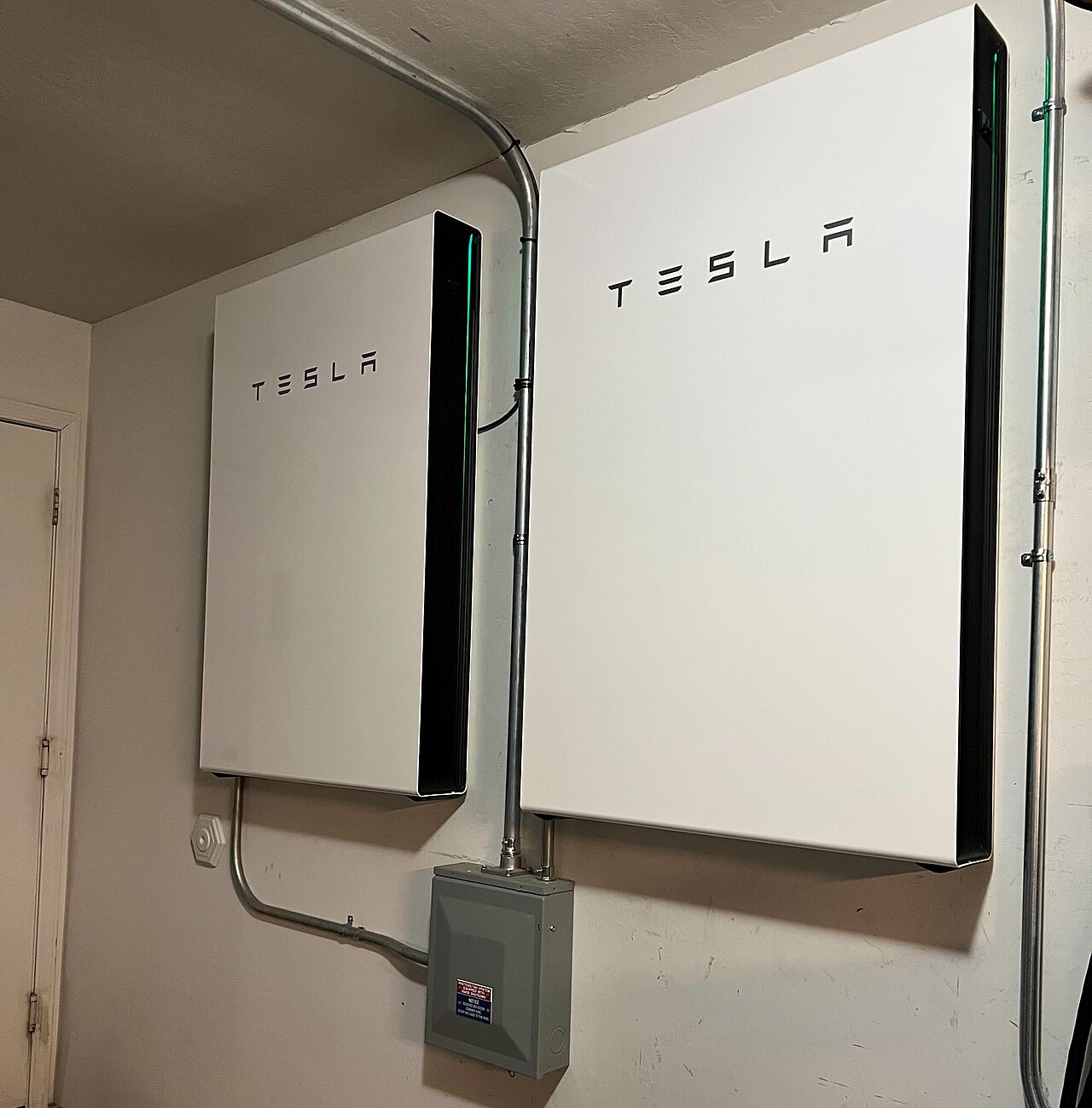 A residential installation of two Tesla Powerwall 3 units showing metallic conduit runs and a wall-mounted AC disconnect switch. Stacking units increases stored energy (kWh) and continuous power, but adds equipment and wall-space requirements. Photo: Rsparks3 / Wikimedia Commons (CC0 Public Domain).
Power (kW) vs. Energy (kWh): how long 13.5 kWh actually lasts
Homeowners routinely confuse kilowatts (kW) with kilowatt-hours (kWh). Kilowatts measure how many appliances can run at the same instant (11.5 kW equals 48 amps at 240 volts). Kilowatt-hours measure the size of the fuel tank (13.5 kWh).
To estimate first-pass runtime for a single Powerwall 3 before inverter conversion losses, backup reserve margins, and temperature effects:
Theoretical Runtime (Hours) = 13.5 kWh ÷ Average Backed-Up Load (kW)Look at what happens to a single 13.5 kWh unit as you add heavy 240-volt circuits during a dark winter storm with little solar recharge:
| Backed-Up Household Load Scenario | Illustrative Average Draw | Theoretical Runtime on 1× Powerwall 3 (13.5 kWh) | Practical Takeaway for System Design |
|---|---|---|---|
| Essential Circuits Only (fridge, Wi-Fi router, LED lights, gas furnace blower, phone charging) | 1.0 kW to 1.5 kW | ~9.0 to 13.5 hours (before reserve & losses) | One battery bridges overnight outages when heavy 240V loads are excluded |
| Essentials + Cycling Central AC or Heat Pump (moderate duty cycle) | 3.0 kW to 4.0 kW | ~3.4 to 4.5 hours | Requires either daytime solar recharge, a second battery unit, or strict thermostat setbacks |
| High-Draw Simultaneous Loads (HVAC + electric water heater or electric cooking) | 6.0 kW to 8.0 kW | ~1.7 to 2.2 hours | Quickly drains a single battery; multi-day whole-home loads favor a standby generator or multi-battery array |
Never let a salesperson size a battery solely from your monthly utility bill average. A house that averages 30 kWh per day on a mild spring week can easily pull 70 to 100 kWh per day during a summer heatwave or winter freeze.
What a 26 kW standby generator requires on site
Generac’s Guardian 26 kW specification sheet (models G007290 and G007291) illustrates the fuel and site realities of a large air-cooled standby unit. While it delivers 22.5 kW on natural gas and 26 kW on liquid propane, that output depends on documented site infrastructure:
- Fuel consumption under load: According to Generac’s specification sheet, at 50% load the 26 kW unit consumes 216 cu. ft./hr of natural gas or 2.37 gal/hr of liquid propane. At 100% full load, consumption rises to 327 cu. ft./hr of natural gas (327,000 BTU/hr) or 3.85 gal/hr of liquid propane.
- Gas meter and regulator sizing: Many suburban homes have a 250-class residential gas meter sized only for a furnace, water heater, and range. Adding a 327,000 BTU/hr generator frequently requires a utility gas-meter upgrade and a dedicated high-capacity gas line.
- Propane tank autonomy: At half load (2.37 gal/hr), a continuous 48-hour outage consumes roughly 114 gallons of propane—requiring a dedicated 250-gallon or 500-gallon tank rather than small portable cylinders.
- Clearance and exhaust safety: Standby generators produce carbon monoxide and 67 dBA of operating sound at 23 feet. Installation requires strict adherence to manufacturer clearance rules from windows, doors, soffit vents, and property lines.
Central air conditioning and the 185A LRA motor-start check
Running a central air conditioner or heat pump off backup power is an electrical engineering check, not a marketing slogan. Every compressor has two current ratings on its outdoor metal nameplate:
- RLA (Rated Load Amps): The steady current the compressor draws once spinning.
- LRA (Locked-Rotor Amps): The instantaneous inrush current required to start the stalled rotor from a dead stop—often 4 to 6 times higher than the running current.
Tesla rates one Powerwall 3 at 185A LRA load-start capability. However, whether your specific 3-ton, 4-ton, or 5-ton compressor starts cleanly during an outage depends on what other household loads are drawing power at that millisecond, conductor voltage drop, and the compressor’s mechanical state. Where an older single-stage condenser has a high LRA, a listed HVAC soft-starter approved by the equipment manufacturer can reduce peak inrush current, but it must be tested under actual off-grid load.
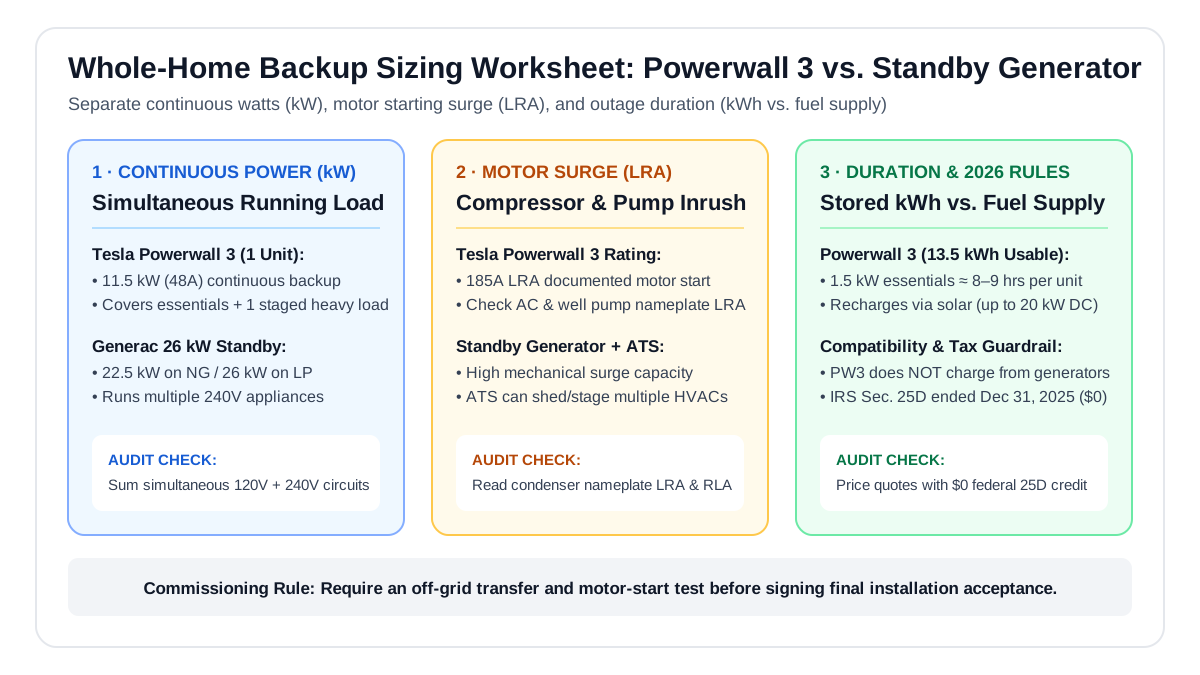 Engineering worksheet: separate simultaneous running power (kW), motor starting surge (LRA), and outage duration (kWh vs. fuel supply), then verify performance during an off-grid commissioning test.
Equipment compatibility boundaries: solar inverters, third-party batteries, and generators
When designing a whole-home backup system, homeowners often wonder whether a Powerwall 3 can integrate with existing equipment or work alongside a portable generator during extended storms. Tesla’s official engineering guidelines establish four distinct equipment boundaries:
- DC-coupled solar (direct connection): Powerwall 3 includes an integrated solar inverter with 6 MPPT inputs accepting up to 20 kW DC directly from rooftop photovoltaic strings, eliminating the need for a separate third-party solar inverter on new installations.
- Third-party solar inverters (AC-coupled solar): Supported on retrofits. If your home already has solar panels paired with a third-party inverter (such as Enphase microinverters or SolarEdge), Tesla’s official System Design: AC-Coupled Solar System Sizing guide confirms that AC-coupled solar can be backed up alongside Powerwall 3. Under Tesla’s official sizing rules, a single Powerwall 3 supports up to 7.68 kW AC of third-party PV inverters in the backup circuit (increasing to 10 kW AC when paired with Powerwall 3 Expansion units). When operating off-grid during an outage, Powerwall 3 uses microgrid frequency shift to safely curtail excess third-party solar if generation exceeds battery charge acceptance.
- Third-party energy storage systems (batteries): Unsupported. Powerwall 3 cannot be paralleled or co-managed with non-Tesla residential battery systems. Expanding storage capacity requires stacking additional Powerwall 3 units or dedicated Powerwall 3 DC Expansion packs.
- Upstream standby & portable generators: Unsupported for battery charging. Tesla’s official Powerwall Compatibility Table explicitly marks charging Powerwall from an upstream generator as unsupported. Do not attempt to wire a portable generator inlet upstream of a Powerwall 3 expecting the battery inverter to accept generator AC power. Portable and non-compatible generators produce voltage and frequency waveforms that fall outside grid-forming inverter tolerances, creating severe equipment damage and backfeed hazards. If a home uses both a standby generator and a Powerwall 3, a listed automatic transfer switch (ATS) must completely isolate the generator from the battery system.
The 2026 IRS Section 25D tax credit cutoff—and how to audit TOU savings claims
Two financial claims appear in almost every residential battery pitch and require strict verification in 2026:
1. Federal Section 25D credit is $0 for installations after December 31, 2025
According to the IRS’s official guidance for Public Law 119-21, the 30% Residential Clean Energy Credit under Internal Revenue Code Section 25D terminated for property placed in service after December 31, 2025. Even if a homeowner signed a contract or made a deposit in 2025, a battery placed in service in 2026 does not qualify for the federal Section 25D credit. Always compare 2026 battery proposals using $0 federal tax credit, and verify any state or utility storage incentives (such as utility virtual power plant or demand-response programs) directly through the utility’s current program rules.
2. Time-of-Use (TOU) bill arbitrage depends entirely on your utility tariff
Tesla’s Time-Based Control mode allows a Powerwall 3 to charge during lower-priced off-peak hours (or from rooftop solar) and discharge during expensive peak hours. Whether that feature meaningfully lowers your electric bill depends on:
- The exact dollar spread between peak and off-peak kWh rates on your utility tariff.
- Whether your utility allows grid-charging for TOU arbitrage or restricts battery charging to solar export rules.
- How much battery capacity you lock away in your Backup Reserve percentage (every kWh held in reserve for outages cannot be cycled for daily bill savings).
- Round-trip inverter and battery conversion losses.
Refuse any sales proposal that plugs in a generic annual bill-savings figure without attaching your actual utility tariff schedule and backup-reserve assumption.
How to compare contractor quotes and commission the system
Because trenching, gas-meter upgrades, subpanel rewiring, backup gateway placement, and municipal permitting vary wildly from house to house, require itemized written quotes that separate:
- Exact equipment models: Powerwall 3 unit count + Backup Gateway / Backup Switch vs. generator model + ATS amperage rating.
- Backed-up circuit schedule: Every 120V and 240V breaker that will remain energized during an outage, alongside any circuits excluded or placed on automatic load-shedding relays.
- Fuel or solar scope: Gas pipe sizing, regulator/meter work, and LP tank installation vs. solar string wiring and MPPT allocation.
- Written commissioning test: Before making final payment, require a live simulated grid outage test where the installer opens the main utility disconnect, verifies automatic transfer, starts the largest backed-up HVAC compressor under realistic house load, and records the measured values.