
A floor-level leak sensor puck only alerts you after water pools against its metal contacts. An inline or clamp-on flow monitor watches your main supply pipe for abnormal flow rates or running durations. A motorized automatic shutoff valve can physically close the incoming domestic water supply when either a flow rule or a linked floor sensor trips. These three categories are complementary plumbing layers—not interchangeable gadgets—and none of them can guarantee zero water damage.
Choosing the right combination comes down to two practical questions: Where could water escape in your house (pressurized supply pipes vs. drains, condensate pans, or groundwater)? and Who will turn off the main valve if a supply line bursts while you are at work or traveling?
This guide was fact-checked on October 18, 2026 against the U.S. Environmental Protection Agency’s (EPA) 2026 WaterSense leak-detection and flow-monitoring guidance and technical reference sheets.
Compare the three layers of residential leak protection
The EPA’s WaterSense technical guidance divides residential leak-protection hardware into three functional categories. Compare what each layer detects, what it misses, and what happens when it triggers:
| Protection Layer | How It Detects a Problem | Leaks It Catches Best | Leaks It Cannot Catch or Stop | Installation & Plumbing Scope |
|---|---|---|---|---|
| 1. Point Moisture Sensor (Pucks & Sensing Cables) | Direct liquid contact bridging metal probes on the puck base or along a perimeter sensing rope | Water heater pan drips, washing machine hoses, under-sink traps, ice-maker lines, HVAC condensate pans | Hidden in-wall pipe leaks that travel down framing without touching the puck; cannot turn off water by itself | DIY Placement: Place on floor or drip pan; requires battery checks and audible/app alert testing |
| 2. Whole-Home Flow Monitor (Ultrasonic or Inline) | Measures flow rate, continuous flow duration, or periodic static pressure drop on the main supply trunk | Running toilet flappers, stuck irrigation solenoids, hidden supply-pipe pinhole leaks, burst supply hoses | Non-supply water sources: roof/window intrusion, sewer or drain backups, sump pit overflow, AC condensate | DIY Clamp-On or Plumber Inline: Must be matched to pipe diameter (commonly 3/4" to 1-1/4") and material |
3. Automatic Shutoff Valve (ANSI/CAN/IAPMO Z1349) | Motorized inline ball valve or clamp-on quarter-turn handle actuator triggered by flow rules or paired pucks | Actively closes the domestic supply line when a burst hose, prolonged flow, or linked point sensor trips | Water already inside downstream pipes, branches teed off upstream of the valve, drain leaks, or groundwater | Licensed Plumber (Inline) or Clamp-On: Requires working manual quarter-turn ball valve, power, and fire-sprinkler clearance |
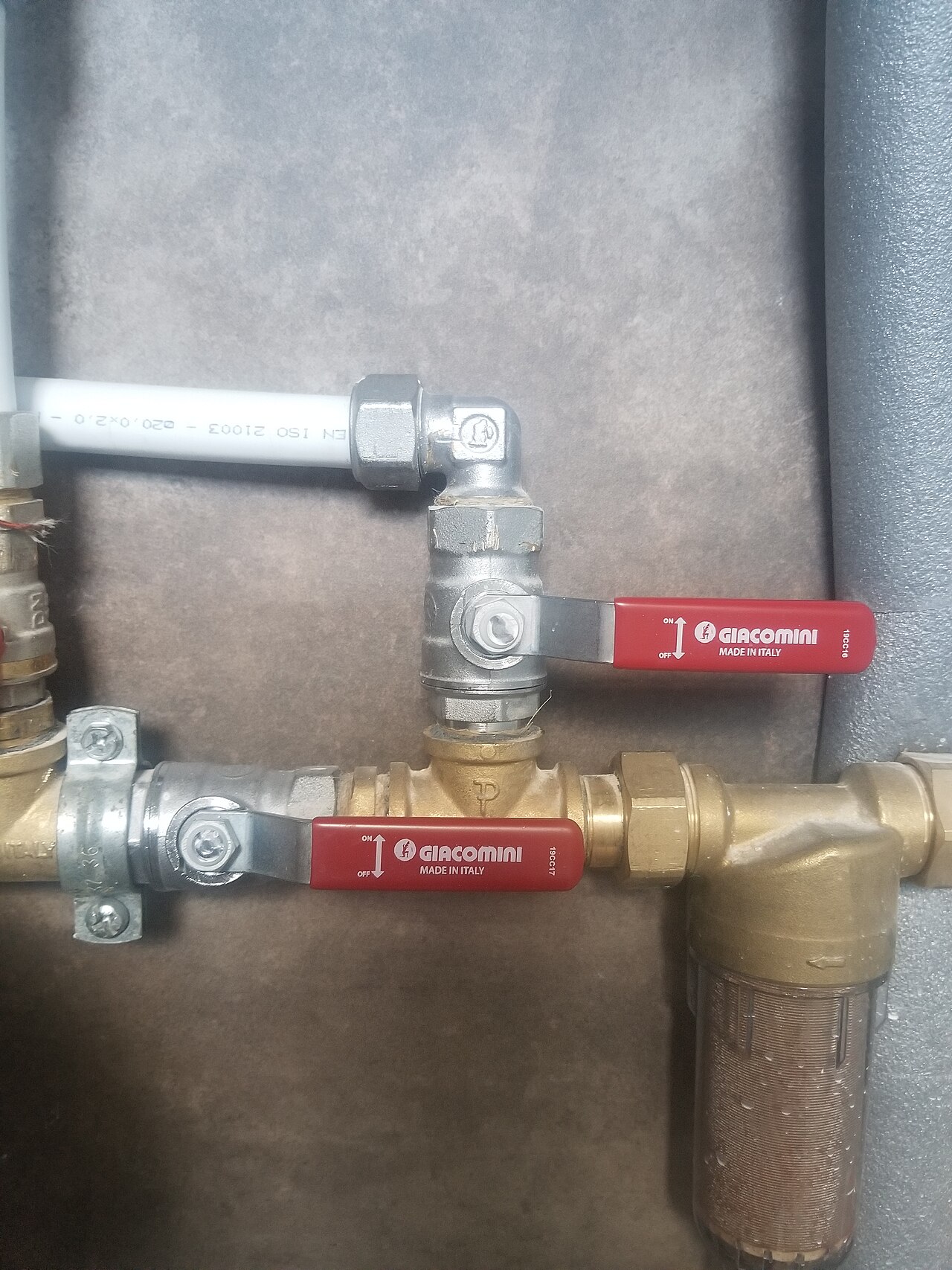 A residential water manifold showing quarter-turn lever ball valves (
ON / OFF) and a branch tee. Clamp-on actuators require a smoothly operating quarter-turn ball valve with adequate lever clearance, while inline smart shutoff valves are cut directly into the domestic main by a licensed plumber. Photo: NVgt156 / Wikimedia Commons (CC BY-SA 4.0).
Why point sensors and main shutoff valves need each other
Relying on only one layer leaves an obvious blind spot:
- Point sensors without a shutoff valve depend entirely on a human seeing a phone alert and reaching the manual main valve in time. If a braided washing-machine supply hose splits while the house is empty for the weekend, a noisy floor puck will warn your phone within seconds while pressurized municipal water continues flowing for hours.
- A flow-sensing shutoff valve without point sensors has to guess whether a 2.5-gallon-per-minute flow is a teenager taking a long shower, a lawn sprinkler zone running, or a broken supply line under the kitchen island. Because flow algorithms delay automatic closure to avoid shutting off the water mid-shower, hundreds of gallons can escape before a time-threshold rule trips—and slow drips from a P-trap drain or HVAC condensate pan never register on the supply meter at all.
When you pair wireless point sensors directly with an automatic shutoff controller, a single drop of water in the water-heater pan or behind the washing machine can command an immediate valve closure without waiting for a 30-minute flow timer to expire.
Map your plumbing boundary before buying an automatic valve
According to EPA WaterSense guidance, point-of-entry flow monitors and automatic shutoff valves must be matched to your home’s exact pipe size, material (copper, PEX, CPVC, or galvanized), static water pressure, and branch topology. Before ordering hardware, trace—or hire a licensed plumber to map—every branch near your main service entry:
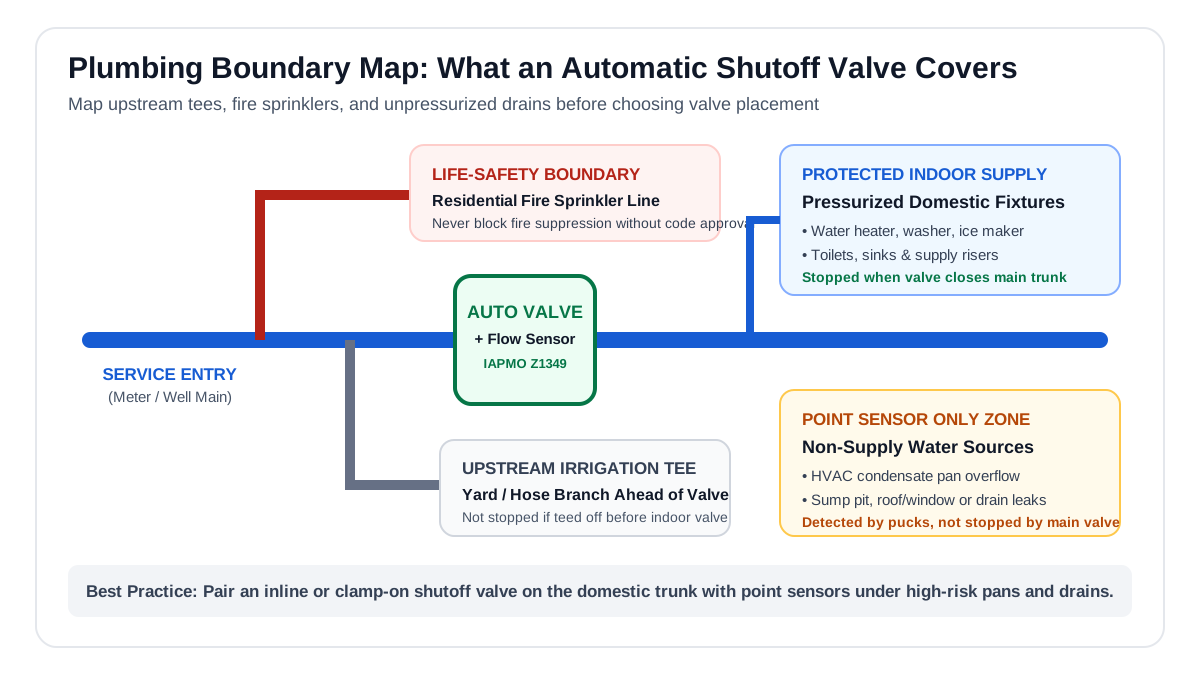 Map every tee before choosing a valve location: residential fire-sprinkler risers must never be blocked by a domestic leak-shutoff valve, and outdoor irrigation lines teed upstream of the valve will not be stopped when the valve closes.
Check these six physical boundaries on site:
- Life-safety fire-sprinkler boundary (critical): EPA’s WaterSense technical sheet explicitly warns that an automatic leak-shutoff device must never be installed where it can cut off water to a residential fire-sprinkler system. The domestic shutoff valve must be installed downstream of the fire-suppression tee in strict compliance with local plumbing and fire codes.
- Upstream irrigation and hose bibbs: In many suburban homes, lawn irrigation and exterior hose bibbs branch off near the meter pit or immediately inside the foundation wall. If the smart valve is installed downstream of the irrigation tee, it will avoid nuisance shutoffs when sprinklers run—but it will not detect or stop a ruptured underground sprinkler manifold.
- Valve body type (multi-turn gate/globe valve vs. quarter-turn ball valve): Clamp-on retrofit actuators only work on standard quarter-turn lever ball valves (typically
1/2",3/4",1", or1-1/4"). If your home still has an old round-wheel gate or globe valve—or a stiff, corroded ball valve that takes two hands to turn—a plumber must replace the manual valve first. - Straight pipe clearance and support: Inline ultrasonic flow monitors and motorized valves require several inches of straight, unobstructed pipe and proper hanger support so the actuator’s weight does not stress PEX or solder joints.
- Power and local wireless link: Motorized valves need a nearby 120-volt receptacle (or a rated low-voltage power run/battery backup). If a sensor puck triggers the valve over local sub-GHz radio, Zigbee, Z-Wave, or Thread rather than a cloud server, the shutoff still works when your internet connection is down during a storm.
- Accessible manual override: Verify that every adult in the household can reach the valve and turn it off or on manually with a clutch pin, hex key, or lever if the motor or power supply fails.
What certification actually means: ANSI/CAN/IAPMO Z1349
While you will see water-efficiency labels on toilets and faucets, EPA WaterSense does not currently issue a WaterSense label for leak-detection or flow-monitoring devices. Instead, the EPA’s February 2026 WaterSense consumer guide directs homeowners and insurers to look for products independently certified to ANSI/CAN/IAPMO Z1349 (Standard for Devices for Detection, Monitoring or Control of Plumbing Water Supply Leaks).
Certification to ANSI/CAN/IAPMO Z1349 verifies that the specific model was tested against industry standards for leak detection, flow monitoring, and/or physical valve shutoff reliability and operating temperatures. When comparing devices, verify the exact model number on the certifying body’s public listing rather than relying on vague “plumber tested” badge graphics.
Where to place point sensors for maximum coverage
Even if you install an inline shutoff valve, place point moisture pucks or sensing ropes at the locations where both pressurized supply leaks and unpressurized drain or condensate leaks start:
- Water heater drip pan: Especially critical for tanks located in upper-floor closets, attics, or finished basements.
- Washing machine recess or laundry floor: Behind the cold/hot supply valves and standpipe drain.
- Kitchen sink cabinet and dishwasher toe-kick: Route a sensing cable under the garbage disposal, P-trap, reverse-osmosis filter housing, and dishwasher supply elbow.
- Refrigerator ice-maker and water-dispenser line: Behind the fridge where plastic or braided tubing coils.
- HVAC air-handler condensate drain pan: A clogged condensate drain overflows water produced by the cooling coil—a leak that a main water-supply flow meter can never see.
- Sump pump pit rim and basement utility floor: Set an early-warning puck just above the normal float-switch activation line to catch a failed sump pump before water reaches the basement slab.
How to verify homeowners insurance discounts before you buy
Many smart-valve manufacturers advertise that their hardware “pays for itself” through homeowners insurance premium reductions. As EPA WaterSense notes, some insurance carriers offer policy credits—most commonly when an automatic shutoff valve (rather than passive floor pucks alone) is professionally installed. However, discounts, eligible model lists, and underwriting rules vary completely by insurer and state.
Before ordering a valve for an insurance credit, call your agent or underwriter and get written answers to five questions:
- Which exact device categories or model numbers qualify under my current policy (any ANSI/CAN/IAPMO Z1349 shutoff valve, or only specific partner brands)?
- Does the insurer require a licensed plumber’s paid invoice and installation certificate?
- Does the credit require an active paid cloud subscription or central-station monitoring certificate at every annual renewal?
- What is the exact annual dollar reduction on my policy premium (and is a water-damage deductible endorsement attached)?
- What documentation is required each year to keep the discount active?
Treat any verified premium credit as a bonus rather than a guaranteed ROI calculation. The primary reason to install point sensors and an automatic shutoff valve is limiting the duration of an unattended supply leak—and testing the sensors and valve movement every six months is what keeps that protection working.