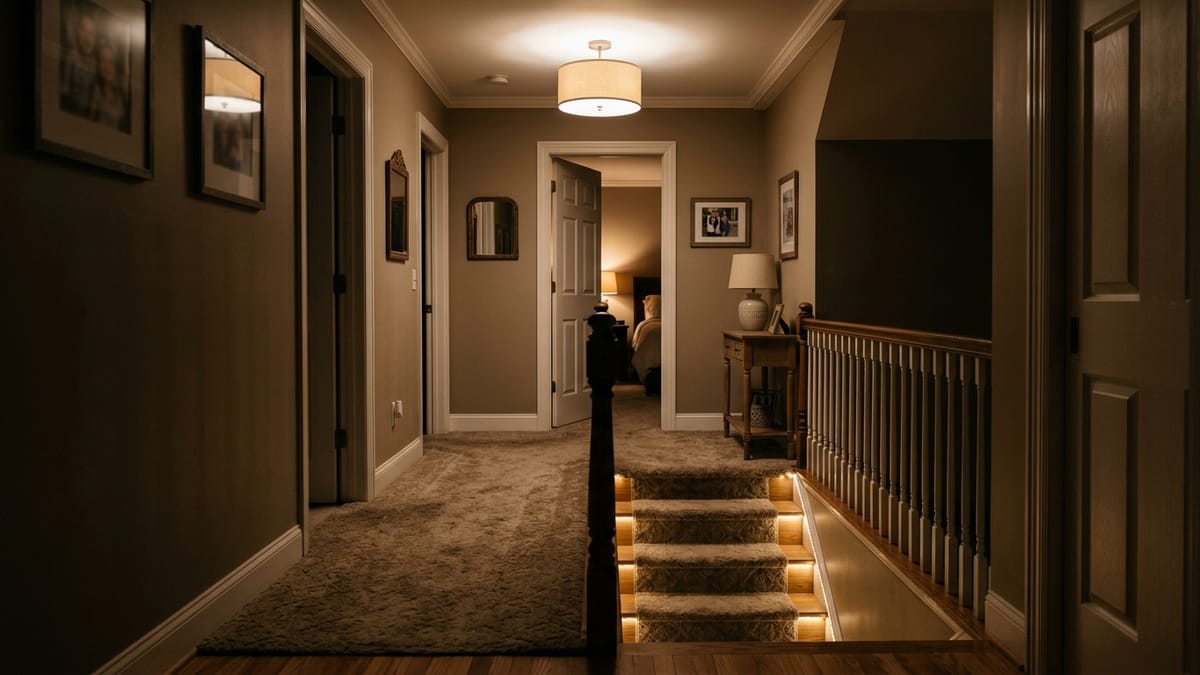
The best place to think about smart lighting is not the bulb aisle. It is the path you actually walk at night.
Maybe it is the short hallway between the bedroom and bathroom. Maybe it is the landing near the stairs. Maybe it is the route from the garage door to the kitchen when someone gets home late. In those moments, the problem is usually not that the house needs an elaborate lighting system. The problem is simpler: the light is not quite where you need it, when you need it, in a way the whole household will tolerate.
That is the most useful frame for smart lighting. It can add convenience, but it is not automatically better than a normal LED bulb, a small night light, or a lamp on a timer. For many homeowners, the right first move is to make one nighttime route feel easier before trying to automate a whole floor.
Start With the Walk, Not the Device
Choose one path in the home and picture how it is used after dark. A bedroom-to-bathroom route has a different problem than a front-entry landing. A guest-room hallway is different from a kitchen path someone uses for a glass of water. The switch may be in the wrong place. The existing bulb may feel too harsh. A lamp may already be nearby, but no one wants to leave it on all evening.
The better question is not “Which smart light should I buy?” It is “What would make this one route less annoying?”
That question keeps the project small. Sometimes the answer is a softer bulb. Sometimes it is a tiny plug-in night light. Sometimes it is a lamp that turns on during a predictable evening window. Sometimes smart control is useful, but only after the ordinary fixes have had a fair chance.
If you are still early in smart home planning, it may help to revisit the broader questions to ask before buying your first smart home device. Lighting can be a friendly category to start with, but only when the problem is clear.
The Simple Choices Before a Smart Routine
There is nothing wrong with choosing the least technical answer. A small night light can be a perfectly reasonable fix for a hallway or bathroom-adjacent area that only needs a little orientation light. It does not need Wi-Fi, a phone, a hub, or anyone in the house remembering which app controls it.
The next simplest improvement is often the bulb itself. If the current light is too bright, too dim, too cool, or too glaring at night, a different LED bulb may improve the feel of the route without adding automation. Official ENERGY STAR and DOE guidance describe LEDs as much more efficient than traditional incandescent bulbs, but that does not make every bulb swap a guaranteed bill-savings plan. What matters in a real home is what is already installed, how often the light is used, local rates, and household habits.
If there is already a lamp in the right spot, a timer or smart plug may be enough. A hallway table lamp or entry lamp can support an evening routine without changing ceiling fixtures. The important limit is that smart plugs are for plug-in devices that fit the plug’s intended use. They are not a workaround for hardwired lights, wiring questions, or fixtures the device was never meant to control. For more on that category, see Smart Plugs vs Smart Power Strips: What Homeowners Should Know.
Smart bulbs become more interesting when you want dimming, warmer evening light, schedules, app control, or voice control in a fixture that is a good match. The catch is everyday behavior. If someone keeps turning off the wall switch, the bulb may lose power and stop responding. If the bulb is in an enclosed fixture, an unusual lamp, or a dimmer-controlled setup, the exact product guidance matters before you buy.
Motion sensing or a triggered routine is another step up. It can be convenient when a light turns on gently as someone passes through a hallway or entry path. It can also become irritating when the timing is wrong, the brightness is too high, or pets and late-night movement trigger it more often than expected. Automatic lighting should feel like help, not like the house is interrupting you.
Keep Compatibility Plain-English
Lighting compatibility can become technical quickly, but the first pass does not need to be a research project. Look at the fixture, the bulb shape, the wall switch, and the way people actually use that area.
A smart bulb may not be a good fit if the fixture is enclosed, the bulb shape is unusual, the switch is always turned off, or the existing dimmer does not match the product guidance. A smart plug may be practical for a lamp, but it does not control a ceiling light. A motion sensor may be useful in one hallway and annoying in another. The home matters as much as the device.
The same is true for platforms and standards. Matter can be useful compatibility context, especially for newer smart home devices, but it is not a promise that every feature works the same way in every app, platform, or home. If terms like Matter, Thread, Zigbee, or hub are new to you, the plain-English smart home terms explainer is a better place to start than a product spec sheet.
Real Homes Have Constraints
Smart lighting is easiest in a simple room with an easy lamp, a standard bulb, and household members who agree on how the light should behave. Many real homes are messier than that.
Renters may have limits on what they can change. Older homes may have switch layouts that do not match modern smart-lighting assumptions. Some rooms have three-way switches, older dimmers, unusual bulb bases, enclosed fixtures, or lights controlled by switches people habitually turn off.
Those constraints do not mean smart lighting is impossible. They mean the first choice should be modest. If the practical answer requires wiring, switch replacement, fixture changes, or code questions, pause and use manufacturer instructions or a qualified professional. This article is about homeowner-friendly planning, not electrical repair.
For broader setup planning, the Smart Home Setup Checklist for Non-Technical Homeowners is the better companion guide.
What a Good Nighttime Routine Looks Like
A good lighting routine is usually quiet. It does not call attention to itself. It simply makes a repeated path feel less fussy.
That might mean a hallway lamp that turns on gently in the evening. It might mean an entry lamp that is on before a family member comes home late. It might mean a guest-area light that is predictable enough that visitors do not have to learn every switch. It might mean a lamp that turns itself off after the usual evening window.
The common thread is not technology. It is a small friction point that happens often enough to be worth solving.
This is also why smart lighting can pair naturally with other routine-based devices. A homeowner thinking through an entry routine may also be thinking through the tradeoffs in Smart Locks: Convenience, Security, and Common Tradeoffs. The connection is the routine, not a need to automate everything.
When It Is Better to Wait
It is worth waiting if the path is already solved by a simple night light, if household members dislike automatic lights, or if the fixture and switch setup is unclear. It is also worth waiting if the home is a rental and the change needs permission, or if the only reason for buying is that the product looks interesting.
Most importantly, smart lighting should not be treated as a promise about what the home can prevent. Better visibility can be more comfortable and convenient, but it is still only one part of how a household uses the space.
It is also not a wiring project. If the setup depends on electrical work you are not prepared to handle, that is a sign to stop and get qualified help rather than stretching a simple smart home upgrade into something riskier.
This is where many homeowners get into trouble with smart home devices. They buy the device before defining the problem. If that sounds familiar, the article on smart home devices homeowners often regret buying first may be a useful reset.
A Short Pause Before Buying
Before choosing a smart bulb, plug, sensor, or routine, pause for a minute with the actual route in mind.
Ask what is really bothering you: brightness, glare, switch location, timing, or household habit. Notice whether a lamp already sits in the right place. Check whether the fixture is enclosed, dimmer-controlled, unusually shaped, or controlled by a switch people often turn off. Think about what should happen if Wi-Fi, voice control, or the app is unavailable.
For motion-based lighting, imagine normal life before imagining the perfect routine. Pets, guests, early risers, and late-night movement can all make an automatic light feel different from what the product page suggests. A routine that looks clever in an app still has to feel calm in the hallway.
The goal is not to create the most advanced setup. The goal is to avoid buying a device that does not fit the home.
A Practical First Step
Pick one route and solve it in the simplest way you can.
If a night light works, use a night light. If a lamp is already in the right spot, consider a timer or smart plug. If you truly need dimming, scheduling, or app control, then a smart bulb may be worth checking. If automatic behavior would make the route easier and not annoy the household, then a sensor routine might be worth testing.
Smart lighting is at its best when it disappears into the routine. You should not have to think about it every night, explain it to every guest, or troubleshoot it every time someone flips a switch.
Start with the path. Then choose the light.