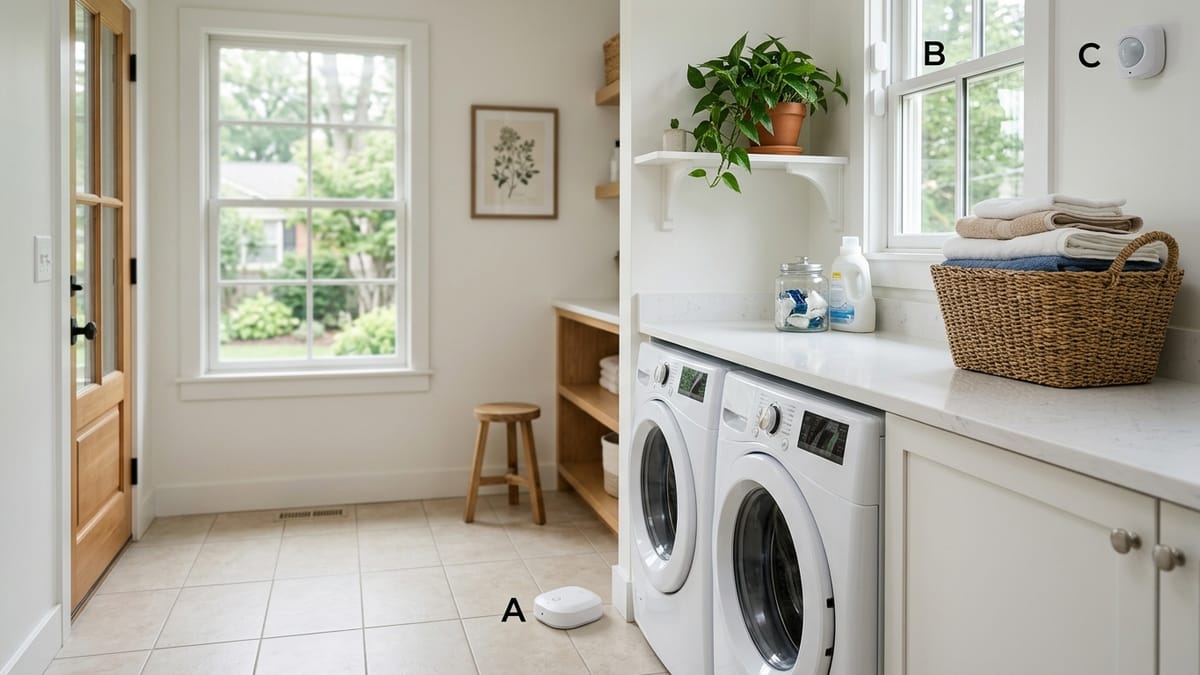
The word sensor covers several small devices that do very different jobs. One notices movement. Another reports that a door has opened. A third reacts when water reaches it. A fourth keeps track of temperature in one spot.
What they share is simple: each notices a particular kind of change and passes that signal along. The signal might help turn on a light, remind you that a door is still open, or prompt you to check an area where water was detected. What happens next depends on the device, its settings, and the rest of the setup.
For homeowners, the useful question is not “Which sensor is smartest?” It is “What change do I want to know about, and what would I reasonably do with that information?”
A Simple Way to Think About Any Sensor
Before looking at the four common categories, it helps to separate three ideas:
- Signal: What change does the sensor notice?
- Response: What alert or routine might that signal support?
- Limitation: What can the signal not tell you on its own?
This is the same basic relationship described in a plain-English smart-home overview: one device notices something, and another part of the setup may respond. Keeping those jobs separate makes product descriptions easier to read—and makes it easier to spot features you do not need.
| Sensor | Signal it can provide | Useful response to verify | What the signal does not establish |
|---|---|---|---|
| Motion | Activity in the monitored area | Light routine or general activity alert | Who moved, why, or whether the home is secure |
| Contact | Open/closed state change | Reminder or routine tied to that state | Who opened it or whether an entry is authorized |
| Leak | Water or moisture reaches the sensing area | Local alarm, app alert, or other documented response | The source, severity, repair, or prevention of damage |
| Temperature | A reading at the sensor’s location | Comfort alert or routine within documented limits | Whole-home conditions or an HVAC, freeze, medical, or food-safety diagnosis |
The third column is the buying test. A sensor has little value if its useful response depends on an account, hub, notification, or connection the household will not maintain.
Motion Sensors Notice Activity in a Space
A motion sensor gives a household a simple kind of information: something moved in the area the device monitors. Most homeowners can begin with that practical meaning rather than the sensing technology inside the device.
That makes motion useful for routines tied to activity. A light might come on when someone enters a room with full hands, for example. Some setups can also produce a general activity notification.
The signal remains narrow. It does not identify the person or explain why movement happened. Think of it as a cue for a routine, not a judgment about identity, intent, health, or whether a home is occupied.
If your main interest is lighting, the examples in smart lighting for hallways and nighttime routines show how a movement-based trigger can fit into a modest household routine without turning it into a safety promise.
Contact Sensors Notice Open and Closed Changes
A contact sensor answers an open-or-closed question. In a typical use, it reports when two parts move together or apart. That can be useful on a door, window, cabinet, or another opening that is easy to forget.
A reminder that a particular door is still open is a good example. The sensor supplies the state change; the reminder is what makes that information useful to the household.
The reading stops at open or closed. It does not tell you who caused the change or why. If cameras or entry devices are part of the same household discussion, it helps to keep their jobs distinct: a contact sensor reports a state, while a camera is chosen for a different kind of information. Neither category should be treated as a guarantee against crime.
Placement examples should remain general because doors, frames, materials, weather exposure, and product instructions differ. Exact positioning belongs in the current instructions for the device being considered, not in a universal rule.
Leak Sensors Notice Water Contact
A leak sensor reacts when water reaches its sensing area. Its job is not to explain the water; it is to give the household an extra reason to check the situation.
Depending on the product and setup, that signal may lead to a local sound, an app notification, or another response. Before buying, check the current support information for what actually happens and what the response depends on.
Once the signal arrives, a person still has to understand the situation and decide what to do. The sensor does not diagnose or repair a plumbing or appliance problem, and an alert is not a promise that damage will be avoided. Routine maintenance, insurance decisions, and qualified help still have their own roles.
This is why a leak sensor is best evaluated with a narrow question: “Would an extra signal in this general area be useful to me?” That is more realistic than treating it as complete protection.
Temperature Sensors Report Conditions at One Location
A temperature sensor answers a local question: what is the temperature where this sensor is reading? That may help a homeowner notice that one room is warmer or cooler than expected, or support a comfort routine.
The word local matters. Sunlight, drafts, nearby equipment, room layout, and the sensor itself can affect what one reading represents. Accuracy, operating range, thresholds, and update behavior are product-specific details that belong in current support documentation.
For an ordinary comfort question, that local reading may be enough to prompt a closer look. It is not a whole-home or HVAC diagnosis, and it should not be stretched into a promise about freezing, medical monitoring, or food safety. More consequential concerns still call for the appropriate alarm, person, or professional response.
The Response Matters as Much as the Sensor
Choosing the category is only half the decision. Two sensors that notice a similar change can create very different experiences. One may sound locally. Another may depend on an app, account, hub, internet connection, or enabled phone notifications. Some may participate in routines with other devices.
Before choosing one, ask:
- Where will the signal appear?
- What has to be powered, connected, signed in, or enabled for that response to work?
- Who in the household needs to receive or understand it?
- What upkeep will the device add?
- What will you do if the alert does not arrive or arrives when you are unavailable?
Those questions are more useful than assuming every connected sensor behaves the same way. The smart-home setup checklist for non-technical homeowners offers a broader way to review accounts, Wi-Fi, updates, and household access before adding another device.
Start With One Household Question
It is easy to read about four sensor categories and imagine buying one of each. A calmer approach is to begin with one recurring question:
- Do I want a light routine to respond to activity in a particular room?
- Would an open-or-closed reminder solve a frequent annoyance?
- Would an extra water-contact signal be useful in one general household area?
- Would a local temperature reading help me understand a comfort issue?
Then apply the three-part check:
Signal: Is this the change I actually care about?
Response: Is the alert or routine useful and manageable for my household?
Limitation: What still depends on a person, routine maintenance, an alarm, insurance, professional help, or emergency services?
That approach fits the broader principle behind simple smart-home upgrades for older homes: prefer a small, reversible choice that answers a real household need before committing to a larger system.
A More Informed Home, Not a Certain One
Motion, contact, leak, and temperature sensors answer different questions. Their common value is awareness: they can supply a signal that supports a useful routine or prompts someone to take a closer look.
Their common limitation is certainty. A signal still needs context, and a connected response still needs upkeep. Maintenance, required alarms, insurance, professional work, and emergency services remain separate responsibilities.
A good first sensor is therefore not the one with the longest feature list. It is the one that answers one modest household question clearly enough to be useful without creating more complexity than it solves.
Sources and Verification Notes
The general connected-device and leak-detection boundaries in this guide were checked on October 10, 2026 against:
- NIST IR 8425: Profile of the IoT Core Baseline for Consumer IoT Products
- NIST IoT Cybersecurity Capabilities Catalog
- U.S. EPA WaterSense: leak detection and flow monitoring devices
Exact sensing range, accuracy, notification path, battery behavior, hub requirement, offline behavior, and maintenance schedule are product-specific. Verify those details in the current instructions for the exact model rather than assuming every sensor in a category behaves the same way.